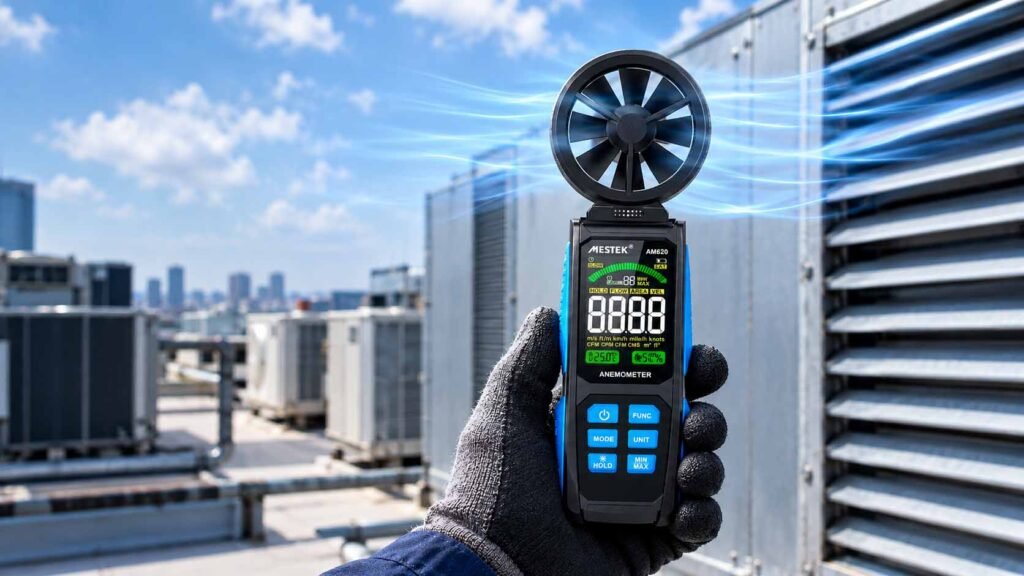
Measuring wind speed with a handheld anemometer looks simple: turn on the meter, point it toward the airflow, and read the display.
However, getting a reliable wind speed measurement involves more than holding the instrument in the air. Sensor orientation, measurement location, airflow conditions, and sampling time can all affect the result.
Choose the Right Anemometer for the Measurement
Before taking a measurement, make sure the anemometer is suitable for the expected airflow.
Check its wind speed range, resolution, accuracy, sensor type, and measurement units. If the expected wind speed is outside the instrument’s specified range, the reading may not provide the accuracy you need.
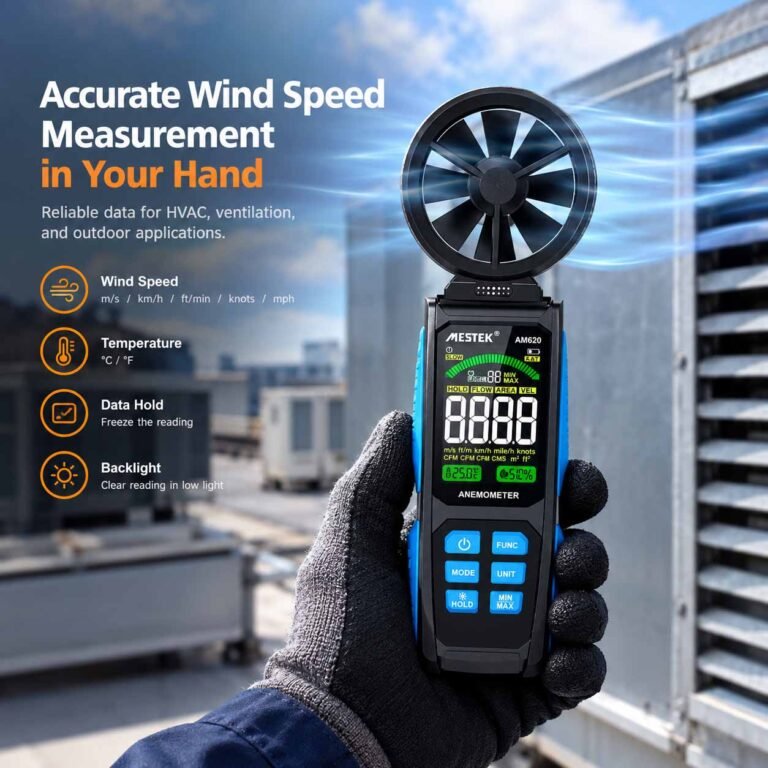
For example, the MESTEK AM610 measures wind speed from 0.8 to 30 m/s, with a resolution of 0.1 m/s and a stated accuracy of ±(3.0% + 0.3 m/s). It also supports five wind speed units, including m/s, km/h, ft/min, knots, and mph.
How to Measure Wind Speed With a Handheld Anemometer
1. Check the Anemometer Before Measuring
Inspect the sensor before starting.
For a vane-style handheld meter, make sure the impeller can rotate freely and that there is no dust, debris, or damage affecting the sensor. A blocked or damaged sensor can produce unreliable readings.
Also check the battery and select the appropriate measurement unit before beginning.
2. Position the Sensor Correctly
Sensor orientation is one of the most important factors in handheld wind measurement.
Place the sensor directly in the airflow rather than holding it at an angle. For outdoor measurements, position the sensor so that the airflow reaches the sensor correctly. When measuring airflow from a vent or other opening, keep the sensor aligned with the direction of the airflow.
Avoid changing the angle or moving the instrument unnecessarily while taking a reading.
The effect of instrument orientation on wind measurements has also been demonstrated in controlled studies, where measurement results varied with sensor orientation.
3. Keep Your Body and Hands Away From the Airflow
Your body, hands, walls, furniture, and other nearby objects can disturb airflow around the sensor.
When using a handheld anemometer, hold the instrument far enough away from your body to avoid blocking the incoming air. Avoid standing directly in front of the airflow when possible.
This is particularly important when measuring in confined spaces or near openings where airflow is already being disturbed.
4. Allow the Reading to Stabilize
Wind speed is rarely completely constant.
Instead of recording the first number that appears on the display, hold the anemometer steadily and allow the reading to settle. If the airflow is fluctuating, take several readings rather than relying on a single instantaneous value.
For example, the MESTEK AM610 and AM620 use rapid sampling and provide a resolution of 0.1 m/s, allowing changes in airflow to be observed during measurement.
For variable airflow, recording multiple measurements can give you a better picture of the actual conditions than one isolated reading.
5. Take Measurements at Consistent Locations
If you are comparing wind speeds at different locations, keep your measurement method consistent.
Try to maintain the same:
- Sensor orientation
- Measurement height
- Distance from the airflow source
- Measurement duration
- Measurement unit
This makes it easier to determine whether a difference in readings comes from the airflow itself rather than from changes in your measurement technique.
Common Mistakes When Measuring Wind Speed
Even a good anemometer can produce inconsistent results if it is used incorrectly.
Measuring Too Close to an Obstruction
Walls, corners, vehicles, buildings, and other objects can change local airflow patterns. If possible, choose a measurement location with sufficient clearance.
Holding the Sensor at the Wrong Angle
A handheld meter should be properly aligned with the airflow. An incorrect orientation can affect the amount of air reaching the sensor and therefore influence the reading.
Taking Only One Reading
Outdoor wind and airflow can change constantly. One reading may represent a temporary gust or decrease in airflow rather than the typical condition.
Taking several measurements under consistent conditions can provide more useful data.
Ignoring the Measurement Range
A meter designed for a particular wind speed range should not be used as though its accuracy is the same across every possible condition.
Always check the manufacturer’s specifications before measuring.
How Accurate Can a Handheld Anemometer Be?
The accuracy of a wind speed measurement depends on both the instrument and the measurement conditions.
The manufacturer’s stated accuracy provides an important reference, but factors such as sensor positioning, airflow turbulence, obstructions, and calibration can also affect the result.
For applications where measurements are used for important technical or compliance decisions, regular calibration and a consistent measurement procedure are especially important. Professional measurement standards also place significant emphasis on sensor orientation, installation, and averaging methods.
However, for routine field measurements, following a consistent measurement procedure can significantly improve the accuracy of readings from handheld devices.
Choosing a Handheld Anemometer
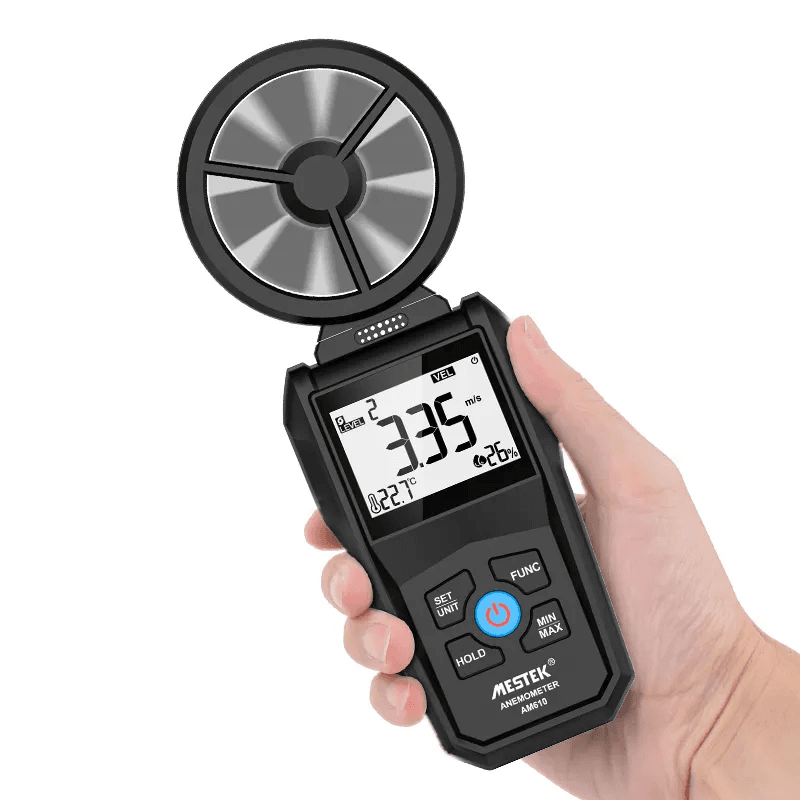
If you regularly measure wind speed, look for an anemometer with a suitable measurement range, clear display, appropriate resolution, and convenient unit conversion.
The MESTEK AM610 and AM620 both measure from 0.8 to 30 m/s, provide 0.1 m/s resolution, and support multiple wind speed units. The AM620 also uses an NTC sensor and provides temperature measurement alongside wind speed.
For applications where portability and quick measurements are important, these functions can make a handheld anemometer easier to use in the field.
Final Thoughts
Accurate wind speed measurement is not simply about buying a more precise anemometer. How you use the instrument matters too.
Choose an appropriate measurement range, position the sensor correctly, avoid airflow obstructions, allow the reading to stabilize, and take multiple measurements when conditions are variable.
With a suitable handheld anemometer and a consistent measurement method, you can obtain more reliable and repeatable wind speed data for field measurements and airflow monitoring.