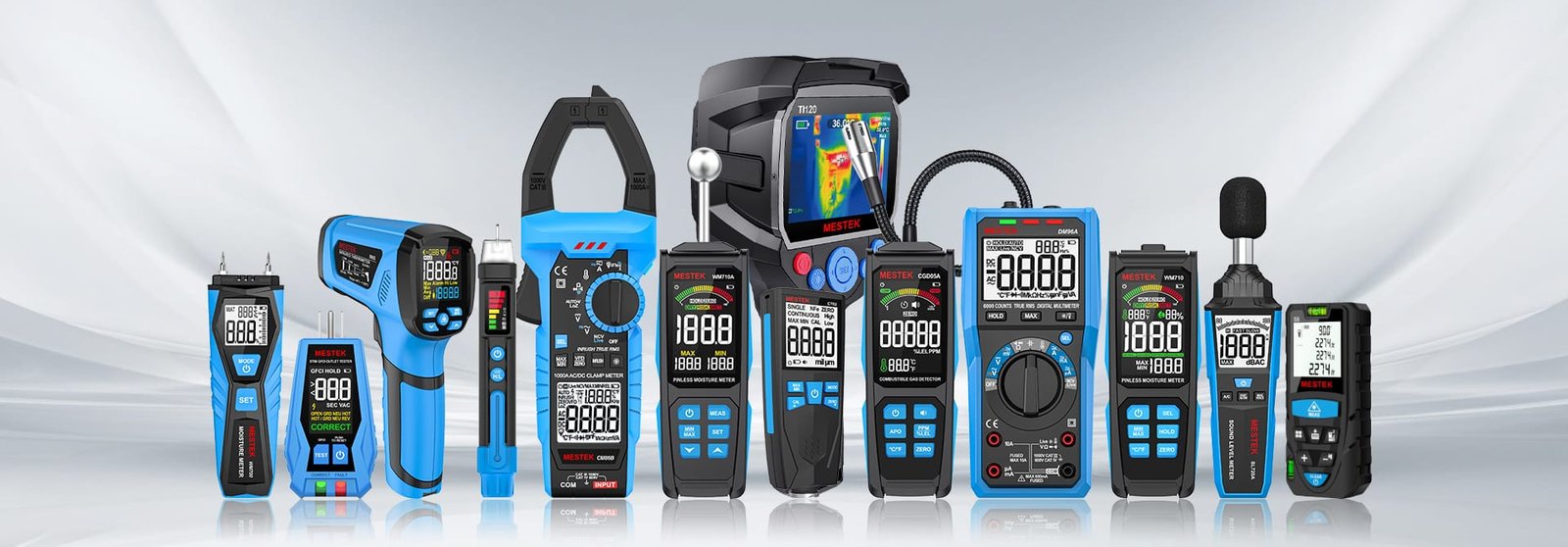
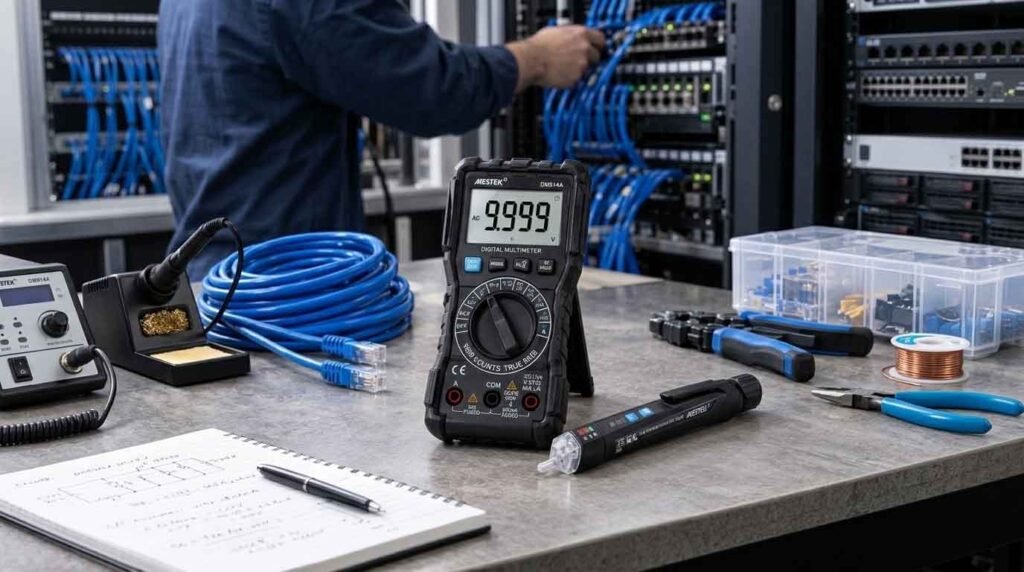
The right low voltage electrician tools make installation, troubleshooting, and maintenance faster and safer. However, a technician building networks needs a different kit than someone diagnosing control wiring or communication systems. A basic toolkit usually includes a wire tracker, non-contact voltage detector, and digital multimeter. You may also need wire strippers, crimpers, punch down tools, and cable management accessories. This guide explains the essential tools for low voltage work and which ones to buy first.
What Does a Low Voltage Electrician Do?
A low voltage electrician, often called a VDV technician or systems integrator, specializes in circuits that typically carry less than 50 volts. While traditional electricians focus on high voltage systems that power appliances and lighting, low voltage specialists handle the infrastructure that enables modern communication and security. Their work encompasses a wide variety of systems, including structured cabling for data networks, telephone and VoIP systems, fire alarms, security cameras, and integrated building automation.
Low voltage work differs from traditional electrical installation because it prioritizes signal integrity over power delivery. Wiring and termination requirements are much more precise. A single poorly crimped connector or a cable bent too sharply can cause signal loss or interference that renders a network unusable. Because these technicians work with delicate electronic components and complex cable bundles, their tool requirements differ significantly. They need instruments that can trace specific signals through massive wire bundles and verify that low power circuits function within strict parameters.
Essential Tools for Low Voltage Electrical Work
The complexity of modern communication systems means guesswork is not an option. A low voltage electrician must verify every connection and troubleshoot issues across vast networks.
The following tools represent the core of a professional kit.
Wire Tracker
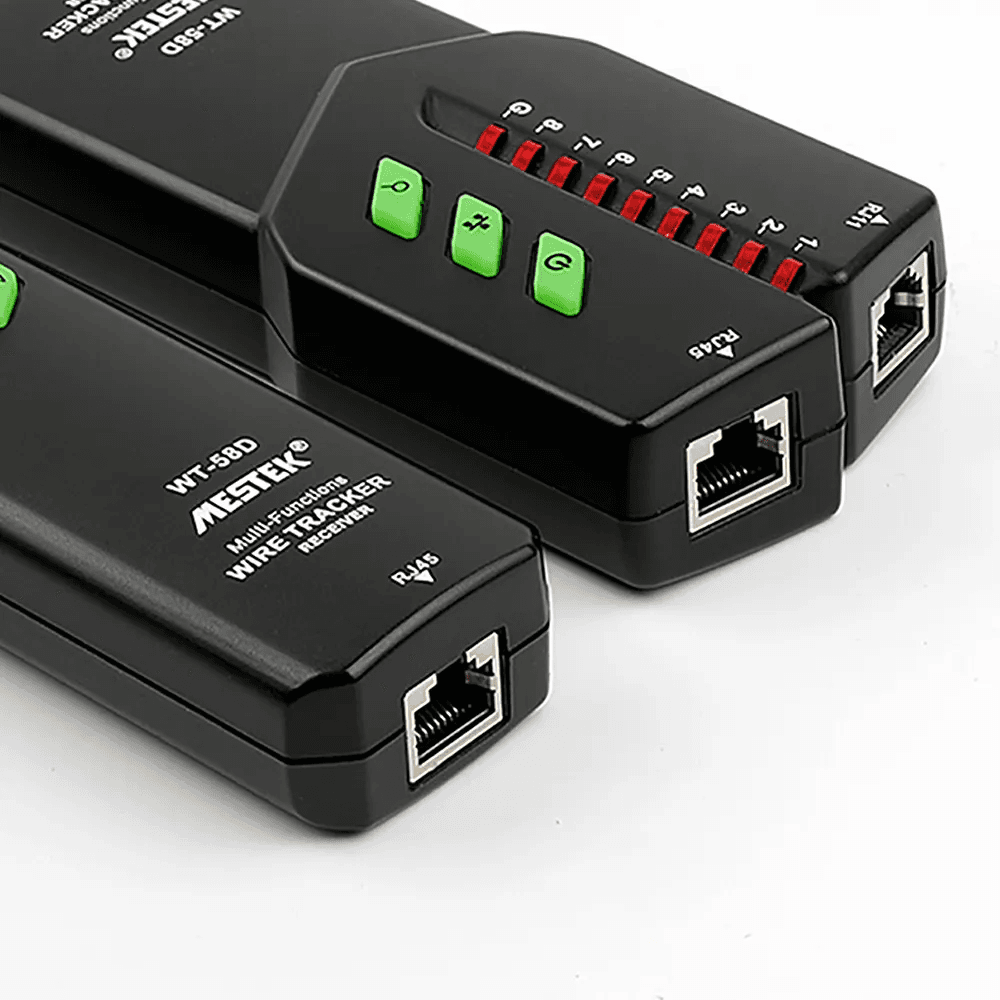
In low voltage cabling, cables are often hidden behind walls or buried in massive bundles in server rooms. Identifying and tracing these cables is one of the most frequent tasks you will face. Without a reliable way to locate a specific wire, a simple repair can turn into hours of guesswork. A wire tracker lets you inject a signal into a line and follow it through the structure with a receiver.
The MESTEK WT58D Wire Tracker is highly recommended for professionals looking for a versatile solution. This device is engineered for network and telephone wiring and is compatible with RJ45 and RJ11 connectors. It uses a digital signal to reduce interference, which is crucial in environments with high electromagnetic noise.
Beyond simple tracing, the WT58D can test cable line sequences to detect open or short circuits and verify the status of working telephone lines (identifying if they are clear, ringing, or busy). Its ability to track wires for POE (Power over Ethernet) switches, provided the DC voltage is below 60V, makes it a specialized asset for modern IT infrastructure.
Non-Contact Voltage Detector

Safety is vital in any electrical work. A non-contact voltage detector provides a quick check for AC voltage before you handle wiring. Even in low voltage environments, there is a risk of “induced voltage” or accidentally crossed lines from nearby high voltage conduits. A detector allows you to verify that a workspace is safe without making physical contact with potentially live components.
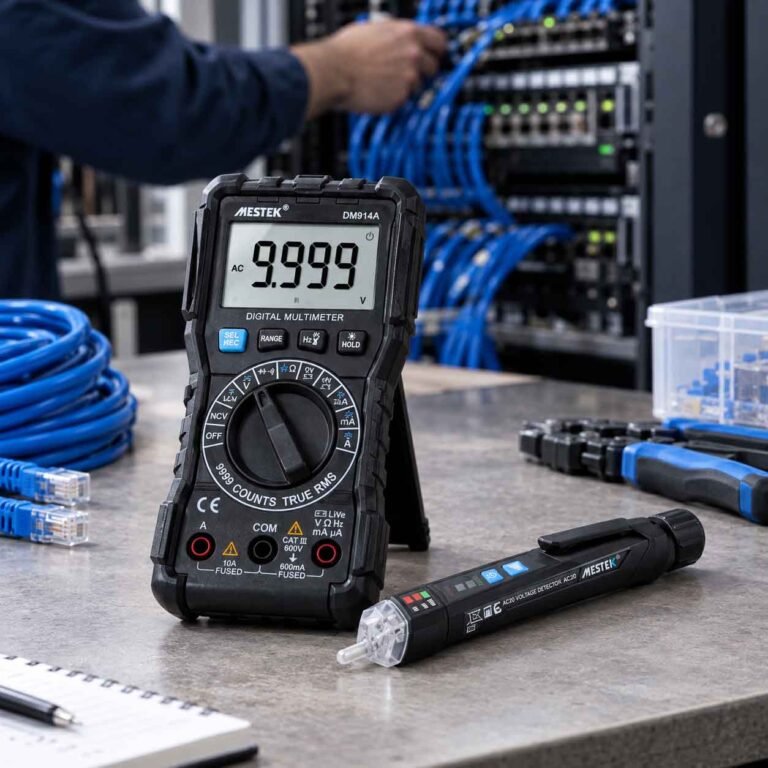
The MESTEK AC20 Voltage Detector is a great tool for these quick safety checks. It features a dual range detection capability, covering both low voltage (12–1000V) and standard high voltage (48–1000V) lines. This sensitivity is especially useful for detecting power in various electrical environments. The AC20 includes audible and visual alerts, using different LED colors and alarm frequencies to indicate signal strength.
It is designed for the rigors of field work. It features a rugged, shock resistant housing that can withstand a 2 meter drop and an integrated LED flashlight for working in dark equipment closets. MESTEK lists CAT III 1000 V safety compliance and a housing designed to withstand a two meter drop.
Digital Multimeter

While trackers find wires, a digital multimeter measures electrical parameters. It is the most versatile diagnostic instrument, used to measure voltage, resistance, and continuity. Whether checking if a power supply is delivering 12V DC to a camera or measuring the resistance of a sensor loop, the multimeter is your primary source of truth.
The MESTEK DM91A Digital Multimeter is a great general purpose testing instrument. It measures DC/AC voltage, resistance, capacitance, frequency, and diodes. Its “smart” mode simplifies operation for novices while providing the data hold and backlight features that experienced professionals rely on during complex troubleshooting tasks. With 6000 digital counts and a CAT III 600V safety rating, it provides the precision needed for fine grained troubleshooting in communication systems.
Other Hand Tools and Accessories
Beyond electronic testers, a low voltage toolkit requires several specialized hand tools. Precision wire strippers are necessary to remove insulation from delicate 22 AWG to 24 AWG wires without damaging the copper conductors. Crimping tools for RJ45 (Ethernet) and RJ11 (Telephone) connectors are also essential for terminating cables.
You also need a punch down tool to connect wires to patch panels or wall jacks. Other common accessories include fish tape for pulling cables through conduits, screwdrivers for mounting faceplates, and cable ties for organizing the finished installation.
Which Tools Should You Buy First?
Your first purchase should match your most common work, not a generic electrician’s checklist.
- For network and telephone work: Start with a wire tracker and cable related tools. The ability to trace RJ45 and RJ11 wiring, confirm cable order, and locate faults can save more time than a broader electrical instrument you rarely use.
- For electrical troubleshooting: Choose a digital multimeter and a non-contact voltage detector. The detector provides a quick preliminary check, while the multimeter supplies measurements for voltage, resistance, continuity, and other diagnostic tasks.
- For general low voltage work: Build a basic testing toolkit with all three core instruments. Then add crimpers, cable testers, fish tape, or specialty adapters as needed for specific jobs.
How to Build a Low Voltage Electrician Tool Kit
Start by listing the systems you service most often. Network cabling, telephone wiring, access control, security equipment, and communication panels may use different connectors and require different testing approaches. Your tool kit should reflect those real jobs.
Next, consider frequency of use. A wire tracker is a strong first investment if you trace cables every day. A multimeter deserves priority if your work involves power supplies, control circuits, or intermittent faults. A pocket size voltage detector is useful across nearly every worksite because it is quick to carry and quick to use.
Check measurement functions before buying. A basic multimeter may be enough for voltage, resistance, and continuity. If you also troubleshoot electronics or control equipment, capacitance, frequency, diode testing, data hold, and a backlight may be valuable. Confirm the meter’s safety category and maximum ratings before using it on any circuit.
Portability matters too. A compact kit is easier to carry through ceilings, equipment rooms, and service areas. Store test leads, batteries, labels, and adapters in one organized pouch so you can begin testing without searching through a large toolbox.
A basic toolkit can start with a wire tracker, voltage detector, and digital multimeter. From there, add tools based on your actual jobs. This keeps your kit practical while allowing it to grow as your skills and services expand.
Conclusion
Success in the field requires more than just skill. It demands the right low voltage electrician tools for every specific challenge. No single device can cover all aspects of cable identification, voltage detection, and electrical measurement. A well rounded toolkit starting with a wire tracker, voltage detector, and digital multimeter provides a versatile foundation for any professional. Choosing high quality instruments ensures both accuracy and long term reliability. Explore MESTEK’s range of electrical testing tools to build a kit that meets professional needs.