Purchasing a thermal camera can be confusing, especially with so many models offering different resolutions, temperature ranges, and advanced imaging features. While two cameras may look similar, their performance in real-world inspections can be dramatically different.
The right choice depends on your application rather than simply choosing the most expensive model. A building inspector, an electrician, and a maintenance engineer often require different capabilities from the same type of device.
This thermal camera buying guide explains the most important specifications you should evaluate before making a purchase, helping you invest in a camera that delivers reliable results for years to come.
Why Choosing the Right Thermal Camera Matters
Thermal cameras are used in a wide range of industries, including electrical maintenance, mechanical troubleshooting, building diagnostics, and predictive maintenance.
Selecting the wrong camera may lead to:
- Missing small overheating components
- Incorrect temperature measurements
- Reduced inspection efficiency
- Unnecessary maintenance costs
- Poor image quality that makes defects difficult to identify
Instead of comparing products by price alone, professional users should evaluate the camera’s performance based on the actual inspection tasks they perform every day.
1. Thermal Resolution Should Be Your First Priority
When comparing thermal cameras, the first specification to examine is thermal resolution.
Thermal resolution refers to the number of infrared pixels used to create the thermal image. More pixels mean greater image detail and improved ability to detect small temperature differences.
For example:
| Thermal Resolution | Typical Applications |
| 80 × 80 | Basic home inspections |
| 160 × 120 | Entry-level maintenance |
| 240 × 240 | Professional industrial inspections |
| 320 × 240 and above | Advanced predictive maintenance |
A higher resolution allows inspectors to identify smaller hot spots from a greater distance without losing important details.
For professionals who regularly inspect electrical cabinets, motors, distribution panels, or industrial equipment, a 240 × 240 infrared resolution provides a strong balance between image quality and affordability.
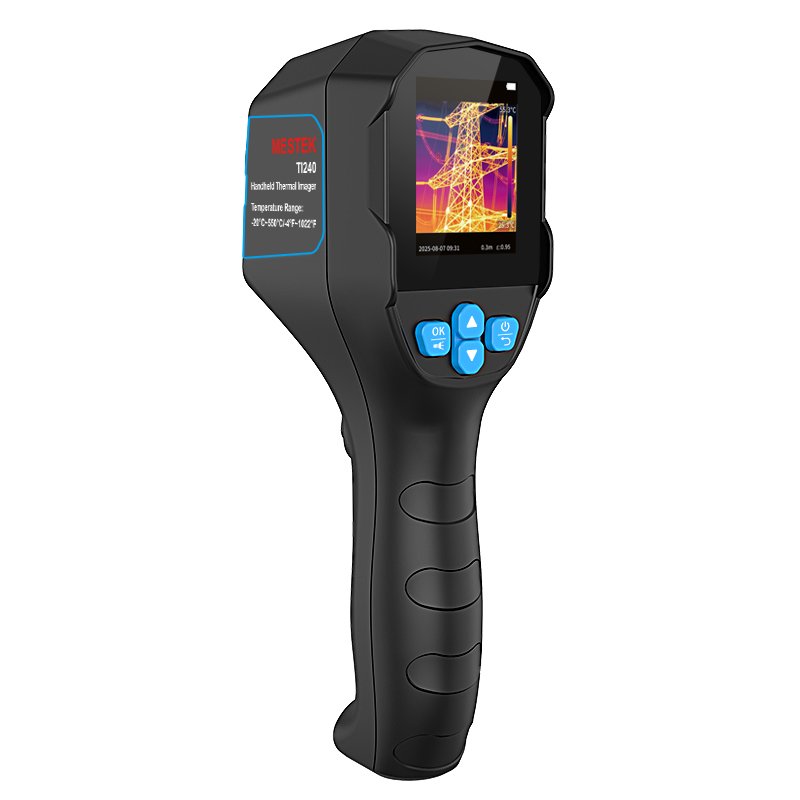
For example, the MESTEK TI240 Thermal Imaging Camera features a 240 × 240 infrared detector, allowing technicians to capture clear thermal images suitable for electrical maintenance, equipment diagnostics, and industrial inspections without moving excessively close to energized equipment.
Rather than purchasing the highest available resolution, users should choose one that matches the level of detail required for their daily inspections.
2. Thermal Sensitivity (NETD) Determines What You Can Actually See
Resolution is only part of the story.
Another specification that many first-time buyers overlook is NETD (Noise Equivalent Temperature Difference), often called thermal sensitivity.
NETD measures the smallest temperature difference a thermal camera can distinguish.
A camera with better thermal sensitivity produces cleaner images and makes subtle temperature variations easier to identify.
This becomes particularly important when inspecting:
- Electrical connections
- Circuit breakers
- Control cabinets
- Bearings
- Insulation problems
For example, two electrical terminals may differ by only a few degrees. A camera with poor thermal sensitivity may display both components in nearly the same color, while a more sensitive camera clearly highlights the abnormal heating.
Professional maintenance cameras typically offer thermal sensitivity below 60 mK, allowing inspectors to detect early-stage faults before they become major failures.
3. Temperature Measurement Range Should Match Your Work
Not every inspection requires extremely high temperature measurements.
Choosing an unnecessarily wide measurement range often increases the purchase cost without providing additional value.
Instead, consider the temperatures encountered during your routine work.
Typical applications include:
| Application | Recommended Temperature Range |
| Building inspection | -20°C to 150°C |
| Electrical inspection | Up to 400°C or higher |
| Industrial maintenance | Up to 550°C |
| Furnace inspection | Above 1000°C |
For most electrical maintenance, facility management, and industrial troubleshooting tasks, a measurement range reaching 550°C is more than sufficient.
The TI240 measures temperatures from -20°C to 550°C, making it suitable for electrical distribution systems, mechanical equipment, preventive maintenance, and many industrial inspection scenarios without requiring a specialized high-temperature camera.
4. Measurement Accuracy Is Just as Important as Temperature Range
A wide temperature range is valuable, but it does not guarantee accurate measurements. For maintenance professionals, accuracy is often more important than measuring extremely high temperatures.
Most professional thermal cameras offer an accuracy of ±2°C or ±2% of the reading, which is sufficient for electrical inspections and industrial diagnostics.
When evaluating a thermal camera, check whether the manufacturer clearly specifies its measurement accuracy. Reliable temperature readings help technicians compare equipment over time, identify abnormal heat patterns, and make maintenance decisions with greater confidence.
The MESTEK TI240 offers an accuracy of ±2°C or ±2%, making it suitable for routine preventive maintenance where consistent temperature measurements are essential.
5. Consider the Field of View (FOV)
The Field of View (FOV) determines how much of a scene the camera captures in a single image.
A wider FOV allows you to inspect large equipment, electrical panels, or building walls more efficiently, while a narrower FOV is better for distant targets.
Typical examples include:
| Inspection Task | Preferred FOV |
| Electrical cabinets | Wide |
| Building inspection | Wide |
| Distant machinery | Narrow |
The TI240 features a 50° × 50° field of view, allowing users to capture a large inspection area without frequently repositioning the camera. This is particularly useful when inspecting switchboards, distribution cabinets, and large mechanical equipment.
6. Image Modes and Color Palettes Improve Inspection Efficiency
Modern thermal cameras do more than display temperature differences.
Useful imaging features include:
- Multiple color palettes
- Visible light image capture
- Image blending or fusion
- High and low temperature alarms
- Adjustable emissivity
Different color palettes help users identify heat patterns under different inspection conditions. For example, Iron, Rainbow, and White Hot palettes each highlight temperature variations differently.
Adjustable emissivity is equally important because different materials emit infrared energy differently. Correct emissivity settings improve measurement accuracy when inspecting metals, painted surfaces, plastics, or electrical insulation.
Instead of choosing a camera based only on resolution, consider whether its imaging functions will improve your daily workflow.
7. Software and Report Generation Save Valuable Time
Capturing thermal images is only part of the inspection process.
Most maintenance engineers also need to:
- Store inspection images
- Compare historical data
- Create maintenance reports
- Share findings with customers or colleagues
A thermal camera with convenient image storage and report generation capabilities can significantly reduce post-inspection work.
The TI240 supports external storage using a Micro SD card, making it easy to save inspection images for future analysis and documentation.
For companies performing regular preventive maintenance, organized inspection records are often just as valuable as the temperature measurements themselves.
8. Don’t Ignore Ease of Use
A thermal camera should be comfortable enough to use throughout an entire working day.
When comparing different models, consider:
- Screen size and visibility
- Button layout
- Weight
- Battery life
- Startup speed
- Menu design
A lightweight and intuitive camera allows technicians to complete inspections more efficiently, especially when working on ladders, inside electrical rooms, or in confined spaces.
For many professionals, ease of use has a greater impact on productivity than a small improvement in specifications.
Which Thermal Camera Is Right for Your Application?
Different industries require different thermal imaging capabilities.
| Application | Recommended Features |
| Electrical Inspection | High resolution, wide temperature range, high thermal sensitivity |
| Industrial Maintenance | High resolution, accurate measurement, report storage |
| Building Inspection | Wide FOV, multiple color palettes, good thermal sensitivity |
| Mechanical Maintenance | Accurate temperature measurement, clear image quality |
Rather than purchasing the highest-specification model available, select a camera that matches your most common inspection tasks.
For many professionals involved in electrical maintenance, industrial troubleshooting and facility management, a mid-range thermal camera with balanced performance often delivers the best long-term value.
Common Mistakes When Buying a Thermal Camera
Many first-time buyers focus on only one specification, which can lead to disappointing performance in real-world applications.
Avoid these common mistakes:
- Buying based on price alone.
- Choosing the highest temperature range without considering actual inspection needs.
- Ignoring thermal sensitivity (NETD).
- Overlooking image resolution.
- Forgetting to evaluate software and reporting functions.
- Selecting a camera that is difficult to operate in the field.
Taking time to compare all key specifications will help you make a smarter investment.
Frequently Asked Questions
What resolution is best for a thermal camera?
For professional electrical and industrial inspections, a resolution of 240 × 240 pixels or higher provides clear thermal images while maintaining a reasonable cost.
Is a thermal camera better than an infrared thermometer?
It depends on the application.
An infrared thermometer measures the temperature of a single point, while a thermal camera displays the temperature distribution across an entire surface, making it much easier to identify hidden hot spots and abnormal heat patterns.
For a detailed comparison, read our guide on Infrared Thermometer vs. Thermal Camera: What’s the Difference?
What temperature range do I need?
Most maintenance professionals do not need extremely high temperature ranges.
A camera capable of measuring up to 550°C is suitable for electrical inspections, industrial maintenance and many mechanical applications.
Can thermal cameras detect electrical faults?
Yes.
Thermal cameras can identify overheating connections, overloaded circuits, loose terminals, failing bearings, and other abnormal heat sources before they develop into costly failures.
To learn more, see our article on Thermal Imaging for Electrical Inspection in Industry.
Are thermal cameras difficult to use?
Modern thermal cameras are designed to be user-friendly.
With proper training and an understanding of thermal imaging principles, technicians can quickly perform accurate inspections and interpret thermal images effectively.
Conclusion
Choosing the right thermal camera is not about purchasing the model with the highest specifications—it’s about selecting one that best matches your inspection needs.
By comparing thermal resolution, thermal sensitivity, measurement accuracy, temperature range, field of view, imaging features, software capabilities, and ease of use, you can make a more informed purchasing decision and improve inspection efficiency.
For professionals working in electrical maintenance, industrial troubleshooting and facility management, a balanced thermal imaging solution often provides the greatest value. Cameras such as the MESTEK TI240 combine a 240 × 240 infrared resolution, -20°C to 550°C measurement range, ±2°C accuracy, and practical inspection features, making them well suited for a wide range of everyday maintenance tasks without requiring the cost of a high-end industrial system.
Whether you’re purchasing your first thermal camera or upgrading an existing device, focusing on the specifications that truly affect field performance will help you achieve more reliable inspections and better long-term results.