Electromagnetic fields are everywhere in modern homes. From WiFi routers and laptops to refrigerators and electrical wiring, nearly every powered device generates some level of electromagnetic energy.
As EMF meters become more popular among homeowners, one question appears again and again:
What do EMF meter readings actually mean?
Many people purchase an EMF detector, take a few measurements around the house, and immediately encounter numbers they don’t understand. Is a reading of 2 mG normal? Is 10 mG high? Why does the value change from room to room?
This guide explains how to interpret EMF meter readings, what factors affect measurements, and how to build a more reliable picture of your home’s electromagnetic environment.
Why EMF Meter Readings Are Not the Same Everywhere
One of the most common misconceptions is that a home should have a single “EMF level.”
In reality, electromagnetic fields vary constantly depending on:
- Electrical wiring layouts
- Household appliances
- Wireless devices
- Distance from equipment
- Time of day
- Equipment operating conditions
For example, a reading near a refrigerator may increase when the compressor starts running and decrease again a few minutes later.
This is completely normal.
When evaluating EMF meter readings, it is more useful to identify patterns than to focus on a single number.
Understanding the Three Types of EMF Measurements
Not all electromagnetic fields are the same.
Modern EMF detectors often measure three different categories.
Magnetic Fields
Magnetic fields are generated when electrical current flows through conductors.
Common sources include:
- Power lines
- Circuit breaker panels
- Motors
- Household appliances
Magnetic fields are typically displayed in milligauss (mG) or microtesla (µT).
Electric Fields
Electric fields are produced whenever voltage is present.
Examples include:
- Wall outlets
- Extension cords
- Electrical wiring behind walls
Electric field measurements are often expressed in volts per meter (V/m).
RF Radiation
Radio frequency (RF) radiation is associated with wireless communication technologies.
Common RF sources include:
- WiFi routers
- Smartphones
- Bluetooth devices
- Wireless smart home equipment
Because these three field types behave differently, interpreting EMF meter readings requires understanding which measurement mode is being used.
What Typical EMF Levels at Home Look Like
Every home is different, but some general measurement patterns are common.
| Location | Typical Observation |
| Living Room | Usually low to moderate |
| Bedroom | Often low unless electronic devices are nearby |
| Home Office | May increase due to computers and networking equipment |
| Kitchen | Temporary peaks near large appliances |
| Electrical Panel Area | Often higher than surrounding rooms |
Rather than asking whether a reading is “good” or “bad,” it is often more useful to compare measurements between locations.
Large differences may indicate an area worth investigating further.
Why a Single Measurement Can Be Misleading
Many first-time users assume that one reading tells the whole story.
It doesn’t.
EMF levels can change because:
- Appliances cycle on and off
- Wireless devices transmit intermittently
- Electrical loads vary throughout the day
- Measurement position changes
For example, moving an EMF detector just a few inches can sometimes produce noticeably different results.
This is why professionals often take multiple readings before drawing conclusions.
Different Types of EMF Meters
The accuracy of your survey also depends on the type of meter being used.
EMF Meters
EMF meters help users quickly measure electromagnetic fields in homes, offices, and around electronic devices.
A quality EMF meter typically offers features such as:
• Fast response time
• Easy-to-read display
• Multiple measurement modes
• Audible and visual alarms
• Convenient operation for home and everyday environmental assessments
How to Perform a Reliable Home EMF Survey
A structured approach provides better results than randomly scanning rooms.
Step 1: Establish a Baseline
Measure several locations throughout the home and record the readings.
Step 2: Check Key Areas
Focus on:
- Bedrooms
- Home offices
- WiFi router locations
- Electrical panels
Step 3: Record Measurements
Document readings and note nearby equipment.
Step 4: Compare Results
Look for unusually large differences rather than focusing on isolated values.
Step 5: Repeat Measurements
Repeat measurements at different times of day to identify patterns.
Choosing the Right EMF Meter

Not every user needs the same type of instrument.
For occasional spot checks, a basic EMF detector may be sufficient.
However, homeowners looking for more comprehensive environmental assessments often prefer multifunctional EMF meters that can measure magnetic fields, electric fields, and RF radiation.
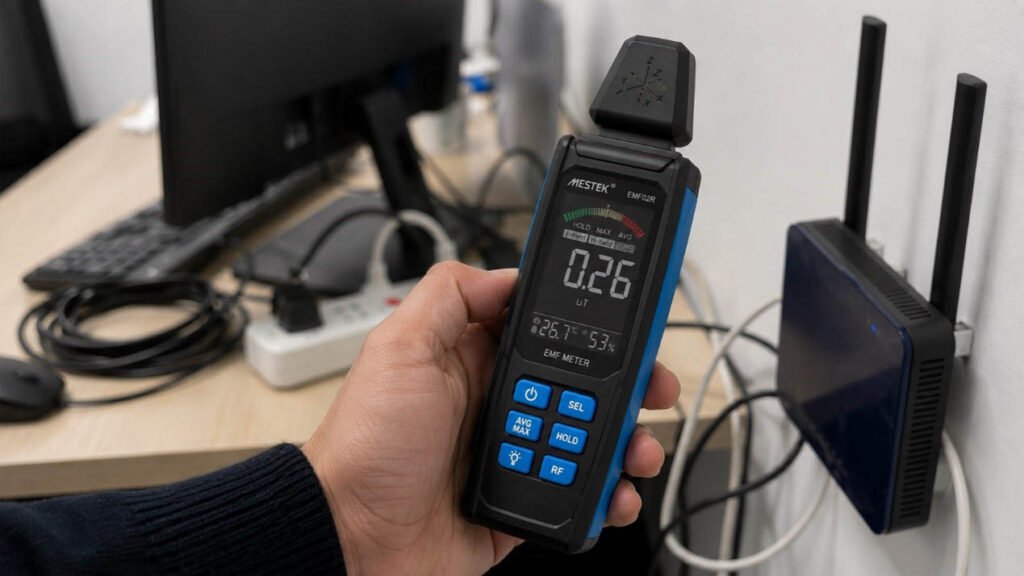
The MESTEK EMF02R features multi-mode measurement, real-time monitoring, and alarm functions, making it suitable for homes, offices, and general environmental EMF assessments.
Frequently Asked Questions
What Is a Normal EMF Meter Reading?
There is no single universal number for every environment. Readings depend on location, nearby equipment, and measurement type.
Why Do My Readings Change Constantly?
Electrical devices and wireless systems operate dynamically. Small variations are expected during normal use.
Can EMF Meters Detect Ghosts?
EMF meters are designed to measure electromagnetic fields produced by electrical systems and electronic devices.
Although EMF detectors are frequently featured in paranormal television shows and ghost-hunting communities, there is currently no scientific evidence that EMF readings can detect spirits or supernatural activity.
In most cases, unexpected readings are caused by wiring, appliances, wireless equipment, or nearby electrical sources rather than anything paranormal.
Final Thoughts
Understanding EMF meter readings is not about searching for a single “safe” number. It is about learning how electromagnetic fields vary throughout your environment and interpreting measurements correctly.
By comparing readings, understanding different field types, and using a reliable measuring instrument, homeowners can gain a clearer picture of their surroundings and make more informed decisions about their electronic environments.