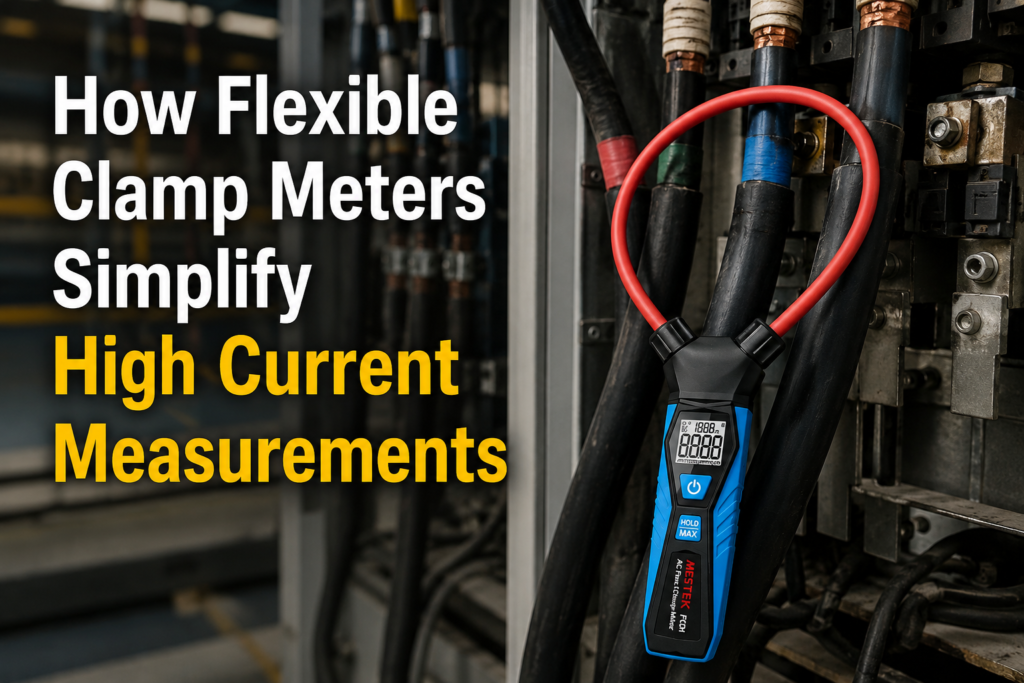
Traditional clamp meters face significant limitations when measuring high current in industrial settings. Large conductors, limited panel access, and densely packed switchgear create scenarios where rigid jaw designs simply do not work. Electricians and maintenance teams working on three phase systems or crowded electrical panels often struggle to position standard meters around oversized cables. The flexible clamp meter addresses these challenges directly. It offers a practical solution for difficult measurement environments where precision and accessibility matter most. This article explores why high current measurements are difficult and how flexible clamp meters solve these challenges.
Why High-Current Measurements Are Difficult
Industrial electrical systems introduce measurement challenges that standard clamp meters were not designed to handle. When dealing with 400-amp feeders or motor circuits carrying several hundred amps, physical constraints quickly become a problem.
1) Large Cables Create Access Problems
High current applications require conductors with a substantial cross sectional area. A 500 MCM cable (approximately 0.8 inches in diameter) becomes even larger once you add insulation. In three phase installations, you are dealing with three or four of these cables bundled together. Most traditional clamp meters have jaw openings between 1.2 and 2 inches, barely enough for a single large conductor, and completely inadequate when cables are grouped or when you need to measure while they are still terminated.
2) Limited Jaw Opening Restricts Measurement Options
The fixed jaw design of conventional meters creates a hard limit on what you can measure. When working on industrial switchgear, you will frequently encounter bus bars, parallel conductors, and cable bundles that exceed the jaw capacity. This forces technicians to either deenergize the system, which is not always feasible, or attempt risky workarounds that compromise both safety and accuracy.
3) Crowded Panels Compound the Problem
Modern electrical panels pack significant power distribution into compact enclosures. In tight electrical spaces, you are working with minimal clearance between conductors, mounting hardware, and panel walls. Getting a rigid clamp meter into position often requires contorting the tool at awkward angles, and sometimes it is physically impossible to close the jaw around the target conductor without disconnecting adjacent wiring.
4) Bundled Conductors Add Another Layer of Complexity
In industrial facilities, conductors are often bundled in cable trays, conduits, or tied together for organization. When you need to measure current on a specific phase, separating it from the bundle is not always practical. Standard meters force you to either unbundle the wiring, introducing downtime and potential for errors during reconnection, or skip the measurement entirely.
5) Limited Access in Existing Installations
Retrofit situations and maintenance on legacy systems present the worst case scenarios. Conductors may be secured with permanent fasteners, routed through tight bends, or positioned against panel backs with no room to maneuver. The limited access in these environments makes high current measurement with traditional tools frustratingly difficult or outright impossible.
How Flexible Clamp Meters Work?
A flexible current clamp uses a Rogowski coil instead of a rigid magnetic jaw. The coil is lightweight and bendable, allowing it to wrap around conductors of various sizes and shapes.
Unlike standard clamp meters that rely on a fixed jaw opening, the flexible sensing loop can be positioned around cables in confined areas. Once wrapped around the conductor, the meter measures alternating current without direct electrical contact.
The design offers several practical advantages:
- Easier positioning around oversized conductors
- Better access to crowded equipment
- Reduced difficulty when testing hard to reach cables
- Improved flexibility in industrial environments
The operating principle remains simple for field technicians. The coil detects the magnetic field generated by alternating current and converts it into a measurable signal displayed on the meter.
Better for Large Conductors and Crowded Panels
The practical advantages of flexible meters are most apparent in situations where traditional tools fail.
1) Oversized Cables Are No Longer a Problem
When you are measuring current on a 750 MCM feeder or a parallel conductor set, a flexible clamp meter handles it effortlessly. The coil can expand to accommodate conductors several inches in diameter or multiple cables measured simultaneously. There’s no jaw size limitation. If you can loop the coil around it, you can measure it.
This capability is particularly valuable in industrial switchgear where bus bars, large feeders, and parallel runs are standard. A maintenance technician can take readings on 1000-amp services just as easily as on 20-amp branch circuits, using the same tool without adaptation.
2) Industrial Switchgear Becomes Accessible
Switchgear installations typically feature tight spacing, multiple layers of conductors, and limited working room. The flexible coil design allows you to thread the sensor through the available space, around structural elements, and along conductor paths that would be completely inaccessible to a rigid jaw.
In practice, this means you can take measurements without removing covers that would require de-energization, without temporarily disconnecting wiring to create access, and without the safety risks associated with working around exposed conductors in cramped quarters.
3) Tight Electrical Spaces No Longer Block Measurement
Panel retrofit situations often leave minimal clearance around high current feeders. With a flexible meter, you can slide the coil edge on through narrow gaps, then wrap it around the target conductor. The flexible nature of the sensor means you’re not limited by the physical dimensions of a meter body and jaw assembly.
Facility maintenance teams working on older installations particularly appreciate this capability. You can diagnose issues, verify load distribution, and check for imbalances without the extensive disassembly that would be required to fit a traditional meter into position.
4) Easier Conductor Access Without Disconnection
Perhaps the most significant practical advantage is the ability to measure without disturbing the electrical installation. Thread the flexible coil around the conductor while it remains fully connected and secured. This non-invasive approach reduces labor time, eliminates the potential for connection errors during reassembly, and allows for energized measurements that would otherwise require system shutdown.
Why Flexible Clamp Meters Work Well in Three Phase Systems
Three phase systems are widely used in commercial and industrial facilities because they support higher power loads efficiently. However, testing these systems often requires measuring current on multiple large conductors located close together.
1) Simplifies Motor Testing
Electric motors used in manufacturing, HVAC systems, and pumping equipment often operate on three phase power. During maintenance, electricians must measure the current on each phase to identify current imbalances or abnormal load behavior. Flexible coils make this easier because they can wrap around conductors individually, even with minimal cable spacing.
2) Useful for Phase Balancing
Phase imbalance can lead to motor overheating, reduced efficiency, premature equipment failure and increased energy consumption. Technicians performing three-phase measurement need fast and reliable access to each conductor. Flexible coils help simplify this process inside packed motor control centers and commercial distribution systems.
3) Ideal for Large Commercial Systems
Large facilities such as factories, hospitals, and office complexes rely heavily on three-phase infrastructure. These installations frequently involve large conductors routed through crowded enclosures. A flexible clamp meter is well suited for these environments because it combines portability with improved conductor access. This makes it practical for routine inspections, preventive maintenance, and load analysis.
Flexible Clamp Meter vs Traditional Clamp Meter
The differences between traditional and flexible designs become most noticeable in demanding industrial applications.
| Feature | Traditional Clamp Meter | Flexible Clamp Meter |
| Jaw Construction | Rigid iron-core jaw | Flexible Rogowski coil |
| Conductor Size | Limited by a fixed opening | Fits very large/multiple conductors |
| Access | Difficult in crowded panels | Slips into tight electrical spaces |
| Current Range | Often limited (e.g., 400A-1000A) | High current capable (up to 3000A+) |
| Weight | Heavier due to an iron core | Lightweight and portable |
| Primary Use | General residential/light commercial | Industrial electrical testing / High power |
Traditional clamp meters are still useful for everyday electrical work. However, flexible models are far better suited for high-current industrial applications.
Who Should Use a Flexible Clamp Meter?
Flexible clamp meters are ideal for professionals working in demanding electrical environments:
- Industrial Electricians: Working with heavy machinery, VFDs, and large motors
- HVAC Technicians: Handling high-amperage commercial HVAC systems
- Maintenance Engineers: Managing plant-wide electrical performance
- Facility Maintenance Teams: Working in hospitals, malls, and data centers
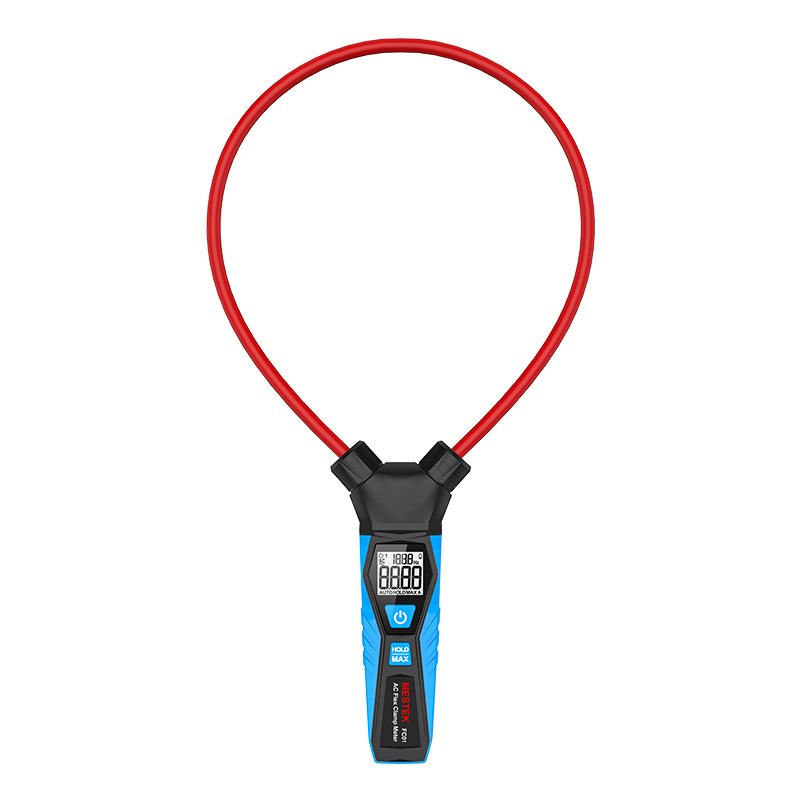
For example, the MESTEK FC01 Flexible Clamp Meter is designed for high-current environments. It features a 520mm flexible Rogowski coil that easily wraps around large conductors and fits into tight spaces. With auto-ranging, a clear LCD display, and backlight support, it provides reliable readings even in low-light industrial conditions.
Final Thoughts
Flexible clamp meters serve a specific purpose in the electrical testing toolkit. They are not universal replacements for conventional meters, but rather specialized tools designed for high current systems, large conductors, and difficult access electrical environments where traditional equipment simply does not fit. For industrial electricians, maintenance engineers, and facility teams working with three phase systems and crowded panels, the flexible design eliminates measurement barriers that would otherwise require system shutdown or extensive disassembly. When your work involves industrial electrical testing and high current applications, the investment in a flexible meter becomes practical rather than optional.