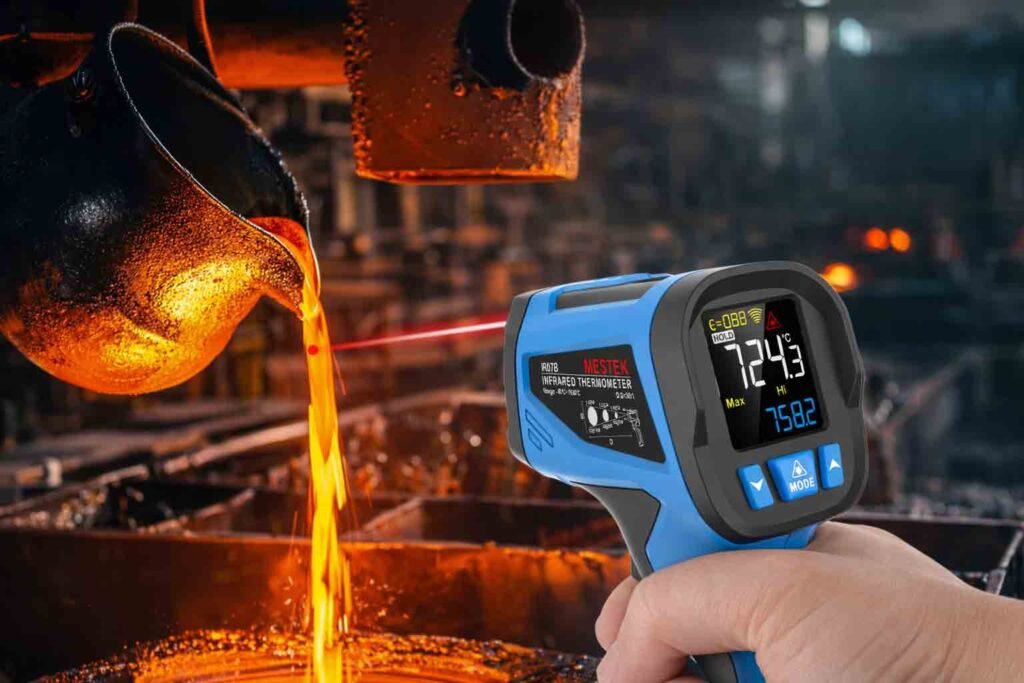
A pyrometer is a specialized non-contact temperature measuring instrument designed to determine the surface temperature of objects, especially at high temperatures where conventional thermometers cannot be used. By interpreting emitted thermal radiation, pyrometers provide fast, reliable readings without touching the target. This makes them indispensable in many industrial settings including steel mills, glass production, power plants, and materials processing.
Why Pyrometers Are Important
In many industrial processes, accurate temperature control is crucial for quality, safety, and efficiency. Direct contact sensors can be impractical or impossible at very high temperatures, moving objects, or hazardous conditions. Pyrometers enable temperature monitoring without contact, eliminating contamination risk and reducing wear and maintenance.
Brief History of Pyrometers
Pyrometers have evolved over centuries. Early forms measured temperature indirectly, such as by observing changes in materials. The first advanced pyrometers appearing in the early 20th century used optical detection principles, where an operator visually compared a heated filament with a target until they appeared the same brightness. Modern electronic pyrometers have since replaced these with precise optical and infrared detection technologies.
How a Pyrometer Works
Pyrometers operate on the principle that all objects emit electromagnetic radiation based on their temperature. The optical system within a pyrometer collects this radiation from the object’s surface and focuses it onto a detector. The detector then converts the incoming energy into an electrical signal, which is processed and translated into a temperature reading.
Core Components of a Pyrometer

Optical System
The optical assembly, including lenses and filters, gathers thermal radiation and directs it to the detector. Filters help isolate the desired wavelength range for accurate measurement.
Detector
Detectors convert the collected infrared radiation into an electrical signal. There are different types of detectors including thermal and quantum detectors, each with unique response characteristics.
Electronics
The electronics amplify and process signals from the detector, translating them into readable temperature values. Modern pyrometers may display results digitally or communicate with external control systems.
Types of Pyrometers
Pyrometers are available in several configurations:
- Single-wavelength pyrometers measure radiation at one specific spectral range.
- Ratio (two-color) pyrometers compare radiation at two wavelengths, reducing the effect of emissivity variation.
- Multi-wavelength pyrometers analyze several spectral bands for greater accuracy under challenging conditions.
Key Considerations When Using a Pyrometer
To ensure accurate readings:
- Choose a pyrometer with a suitable temperature range for your application.
- Understand the distance-to-spot (D:S) ratio — the instrument must “see” only the target.
- Know the surface emissivity — shiny or reflective materials can skew results unless corrected.
- Install and align the pyrometer correctly to avoid vibration or misalignment affecting measurements.
Applications of Pyrometers
Pyrometers are widely used across industries where non-contact temperature measurement is needed:
- Metallurgy: monitoring furnace and molten metal temperatures
- Glass manufacturing: ensuring consistent material properties
- Ceramics and kilns: maintaining precise firing conditions
- Power generation: measuring critical component temperatures
- Process control: integrating with industrial systems for automated monitoring
Conclusion
Pyrometers are powerful tools for non-contact temperature measurement, especially where temperatures are too high or environments too hazardous for contact sensors. Their ability to rapidly and accurately interpret surface radiation makes them essential in industrial temperature control and quality assurance.
Frequently Asked Questions
What makes a pyrometer different from a traditional thermometer?
Pyrometers measure emitted radiation without contact, while traditional thermometers require physical contact.
Can pyrometers measure moving objects?
Yes. Because they use non-contact detection, pyrometers can capture temperatures on moving targets without physical interference.