Extreme industrial conditions require accurate, rapid, and safe tools. When working with furnaces and molten metals temperatures reaching up to 1650°C, traditional contact is dangerous and unreliable. Workers face risks like burns, human error, and exposure to extreme heat.
That is why industrial infrared thermometers (also called pyrometers) are now widely used. The infrared thermometer for furnace devices measures temperature without contact, making it safer and more accurate. This article explains why temperature measurement matters, the challenges involved, key features to look for, and recommends a reliable solution for high temperature applications.
The Critical Role of Temperature in Metal Smelting
Metal smelting is the heating and melting of ores into base metals. When you’re smelting iron, copper or other precious metals, it’s critical to maintain a consistent, accurate temperature. An error of just a few degrees can result in:
- Incomplete Smelting: Resulting in poor metal purity and wasted energy.
- Oxidation and impurities: Overheating can cause chemical reactions that alter the metal’s properties.
- Equipment Damage: Furnaces and crucibles have a limit on their heat output. If this is exceeded the furnace can explode.
- Safety Risks: Uncontrolled thermal spikes in a foundry environment increase the risk of explosions and structural ruptures.
For these reasons, a high temperature thermometer is an important tool to have for every manager and technician in a plant.
Challenges of Furnace Temperature Measurement
It takes much more time to measure the temperature of a furnace or stream of molten metal than it does to measure the temperature of a standard industrial motor.
1. Extreme Heat and Hazardous Proximity
Standard thermometers rely on contact with the furnace surface at 1500°C, which is impossible when measuring the interior. Even getting within a few feet of the furnace can expose workers and electronic components to fire.
2. Variable Emissivity of Metals
Emissivity is the measure of a material’s ability to emit infrared energy. Shiny, reflective metals (such as polished aluminum or molten steel) have low emissivity, meaning they reflect the heat of their environment rather than emitting their own. Without a set of industrial infrared thermometers with adjustable emissivity, your readings will be wildly inaccurate.
3. Atmospheric Interference
Foundries and smelting plants are often contaminated with smoke, dust, and steam, which can scatter infrared light and produce “cold” readings if the pyrometer is not designed to handle such particle densities.
4. Moving Targets
In many smelting processes, the metal is moving, either through the furnace into a mold or on a conveyor. Because contact probes cannot track moving targets, non contact infrared technology has been the only option.
Read Also: Infrared thermometer that challenges high temperatures
Advantages of Non-Contact Measurement
The shift from contact-based to infrared thermometers in metal smelting has increased productivity.
- Speed: Infrared sensors provide instantaneous readings (often in less than half a second), allowing for real time process adjustments.
- Safety: Technicians can stay at a safe distance from the heat source, reducing the risk of burns and heat exhaustion.
- No Contamination: Since the device never touches the material, there is no risk of cross contamination or damage to the molten metal’s surface.
- Durability: Because the thermometer isn’t exposed to the corrosive, abrasive environment of molten metal, it lasts significantly longer than traditional thermocouples.
Key Selection Factors for High Temperature Thermometers
Buying an infrared thermometer for a furnace involves checking to see if the device you are purchasing is suitable for your furnace or smelting operation.
1. Wide Temperature Range
The furnace pyrometer should be able to provide the full temperature profile of your furnace. For smelting, temperatures can range from well below freezing for monitoring storage temperatures to at least 1600°C for melting.
2. Distance-to-Spot (D:S) Ratio
The D:S ratio describes the size of the measuring area relative to distance from the target. In a foundry, you might need to measure a small spot, such as the center of a crucible, at a safe distance of 10 or 20 feet. A high D:S ratio, such as 30:1 or 50:1, is needed for precision at range.
A 30:1 ratio means that from 30 inches away, the thermometer reads 1 inch and from 30 feet away, it reads 1 foot. For detailed work in the furnace, a higher ratio is preferred.
3. Adjustable Emissivity
Metals have varying levels of emissivity. Molten iron could have an emissivity of 0.45, while oxidized steel might have an emissivity of 0.85. Any good pyrometer for use in furnaces MUST have adjustable emissivity settings (typically between 0.1 and 1.0) to ensure the unit is calibrated for the material being measured.
4. Optical Resolution
Higher optical resolution allows you to measure smaller targets from greater distances. Professional pyrometers measure small holes as small as 0.6mm in diameter.
5. Build Quality and Durability
Industrial installations require a sensor to be IP65 sealed for water and dust resistance. Sensors must withstand temperatures up to 65°C, while fiber-optic sensors can handle up to 315°C.
6. Response Time and Accuracy
Professional models have a 2-10ms response time. Accuracy is 0.3% to 0.5% plus 1-2°C.
The Ideal Solution: MESTEK IR07B Industrial Infrared Thermometer.
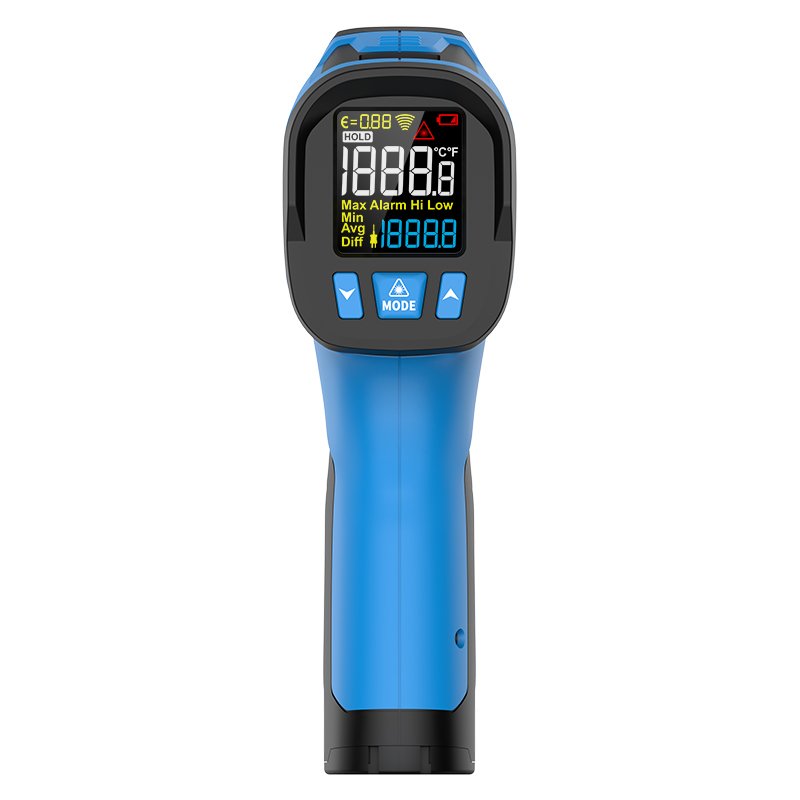
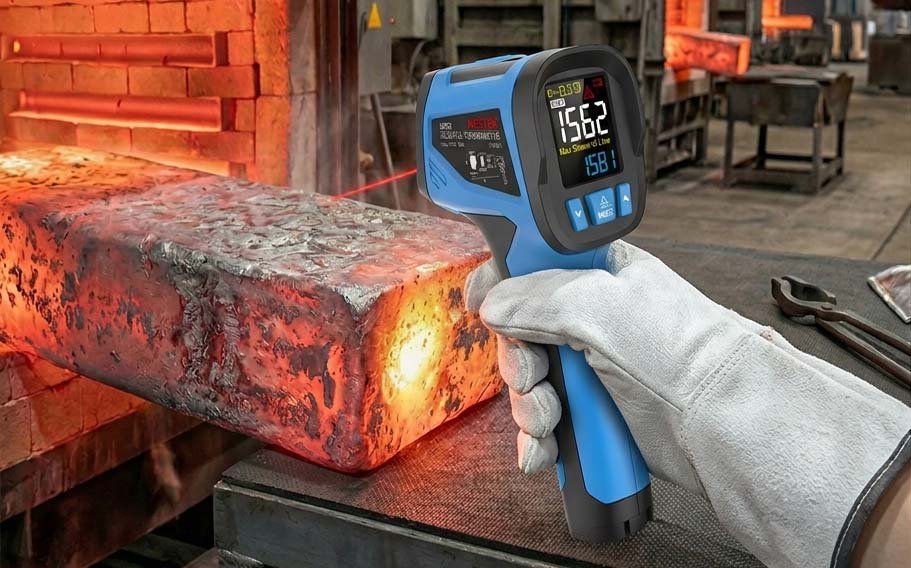
The MESTEK IR07B is a powerful industrial infrared thermometer used in high temperature applications such as in a furnace or metal smelting. It has a very broad temperature span of -40 °C to 1650 °C and is hence applicable in virtually all metal working procedures. You may be tracking molten metal or furnace walls, but this device provides good, fast results.
Its distance-to-spot ratio of 30:1 enables users to gauge temperature from a safe distance without entering risky hot areas. The adjustable emissivity (0.10 1.00) guarantees the correct measurements of various materials, such as shiny metals and oxidized surfaces.
The device also has a VA reverse color display, which makes it easy to read even in bright or dark industrial environments. It has a response time of less than 0.5 seconds and assists in real time monitoring and prompt decision making.
Furthermore, the K-type thermocouple input is flexible, providing contact and non-contact temperature measurement. Altogether, the IR07B is a safe and efficient product that professionals can use in harsh environments.
Key Features:
- Wide temperature range: -40°C to 1650 C.
- Long-range performance: 30:1 distance-to-spot ratio.
- 8-14μm spectral response idealized for industrial use.
- 0.1 C/0.1 F accuracy in readings.
- Compact design: 173×102×54mm, 210g weight
- 2x 1.5 V AA batteries.
- Operating range: 0-50°C, 10-90% RH
- Use in High Temperature Applications.
Applications in High Temperature Environments
The versatility of the IR07B makes it the go-to high temperature thermometer for various sectors:
1. Steel Plants
In steel production, it is vital to monitor the temperature of the blast furnace and during the subsequent rolling process. The IR07B can monitor ladle temperature to keep the steel at the optimal temperature for casting.
2. Foundries
Foundries that process non ferrous metals such as brass and bronze use the adjustable emissivity provided by the IR07B to take into consideration the reflective nature of these alloys to achieve flawless pours each time.
3. Industrial Heating Systems
In large scale boilers and industrial kilns, the IR07B is an indispensable diagnostic instrument. It is used by maintenance teams to investigate thermal leakage and to ensure that heating elements are working within their parameters.
4. Glass Production
Silicon dioxide melts at around 1600 C and this needs accuracy during production. Glass tempering, heating and quenching in conveys or wave furnaces. Overheating enhances distortions, and proper measurement is critical to various glass thicknesses.
5. Metal Processing Plants
The nature of metal production and processing is such that non contact monitoring at temperatures up to 3500 C is required, and contact thermometers are limited in life and require frequent replacement.
Tips for Accurate Furnace Temperature Measurement
Even with the best thermometer, proper technique is important.
- Adjust Emissivity Correctly: Use emissivity tables or compare readings with a thermocouple.
- Avoid Reflections: Shield the target from nearby heat sources to avoid inaccurate readings.
- Measure perpendicular: Aim straight at the target for accuracy.
- Use Matte Coating if Needed: Paint reflective surfaces black to provide better readings.
- Allow Device Stabilization: Let the thermometer settle to room temperature for about 30 minutes.
- Keep the Lens Clean: Dust and fingerprints can affect camera accuracy.
Read Also: Uses of infrared thermometers
Why IR Thermometers Are Essential for Modern Industry
Modern thermometers have become essential devices in manufacturing. They are fast, safe, and accurate, without interrupting operations. Many companies use them for preventive maintenance. Finding overheating early can prevent equipment failure and downtime.
Many industries, such as semiconductors, steel, and metal processing, rely on accurate temperature measurements. Without precise measurements, the quality and safety of products cannot be ensured. Fortunately, with technological advancements, infrared thermometers are more reliable, affordable, and easier to use than ever before.
Conclusion
The choice of the right industrial infrared thermometer will significantly impact the furnace’s operation, including safety, proper temperature control, and cost savings. MESTEK’s IR07B offers high temperature reliability, a wide temperature range, easily adjustable emissivity, and a fast response time.
If you’re looking to improve accuracy, efficiency, and safety, then consider buying an infrared thermometer from a reputable manufacturer. Explore the MESTEK IR07B infrared thermometer for furnace applications here.