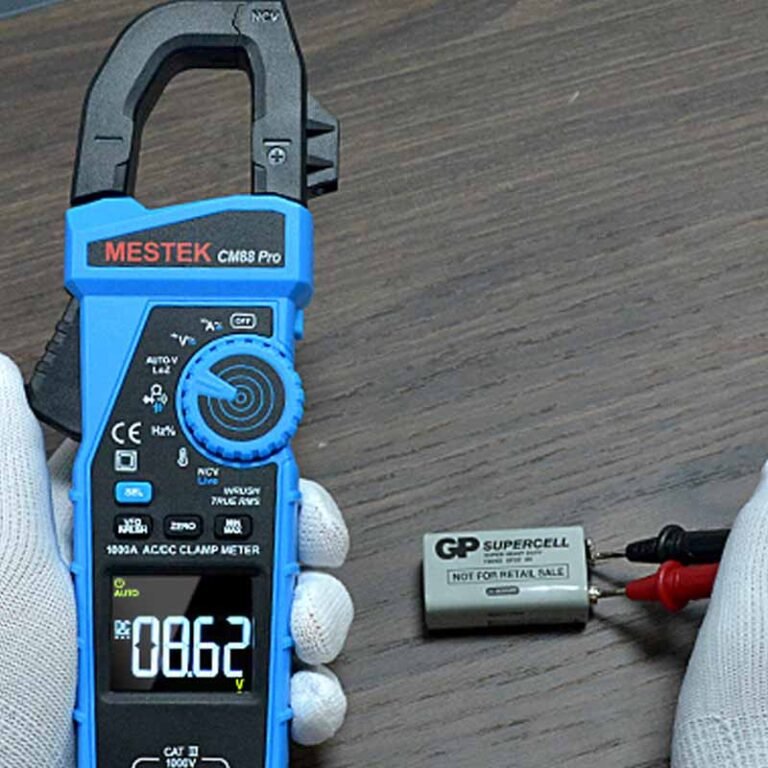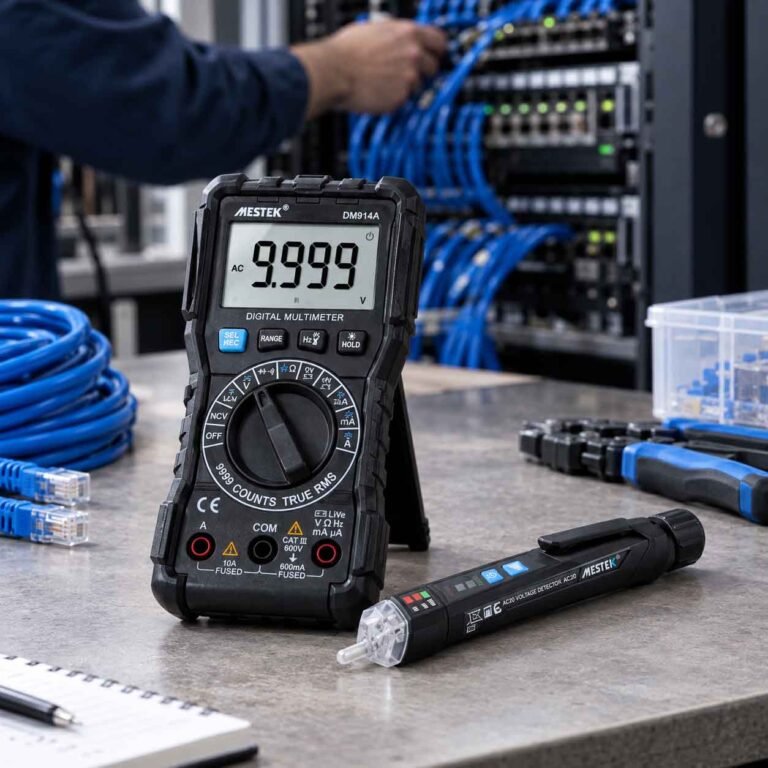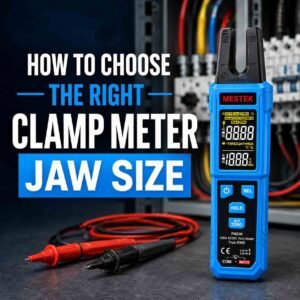
Choosing a clamp meter is not simply a matter of buying the model with the highest amp rating. The right current range depends on what you plan to measure, the expected operating current of the equipment, the possibility of startup surges, and whether you need to measure AC current, DC current, or both.
A 200A clamp meter may be sufficient for many field service and electrical maintenance tasks, while industrial applications may require 600A or 1000A capacity. For specialized high-current applications, a flexible clamp accessory can extend measurement capability even further.
This guide explains how to choose the right clamp meter current range and compares several MESTEK models for different applications.
What Does the Current Range of a Clamp Meter Mean?
The current range refers to the maximum current a clamp meter can measure under its specified accuracy and operating conditions.
For example, a clamp meter rated at 600A can measure currents up to 600A. However, we should try to avoid frequently operating close to the maximum rating. If our equipment typically consumes 550A, then the measurement margin of a 600A clamp meter is relatively limited.
When selecting a clamp meter, the “normal operating current” and the “maximum current that may be encountered” should be considered. The type of clamp meter is also important,some clamp meters can only measure AC current, while others support both AC and DC current measurements.
How Much Current Does Your Clamp Meter Need?
There is no single current range that is ideal for everyone. A useful starting point is to divide applications into several general categories.
| Clamp Meter Range | Typical Applications |
| Up to 200A | Field service, small equipment, residential electrical work |
| Up to 600A | General electrical maintenance, commercial equipment, motors |
| Up to 1000A | Industrial equipment, large conductors, automotive and high-current systems |
| 1000A+ | High-current industrial applications and specialized testing |
Is a 200A Clamp Meter Enough?
For many small electrical systems, a 200A clamp meter is a practical choice. If our primary use is with small wires, residential equipment, field troubleshooting, or general electrical maintenance, carrying a large 1000A clamp meter may not offer much additional benefit.
Furthermore, smaller clamp meters are easier to operate in confined spaces.
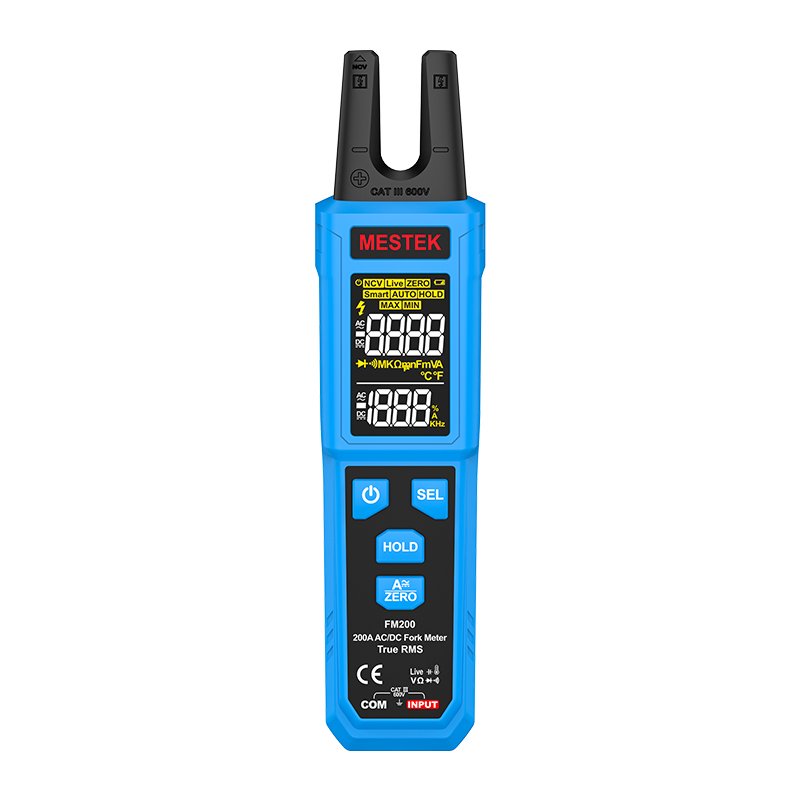
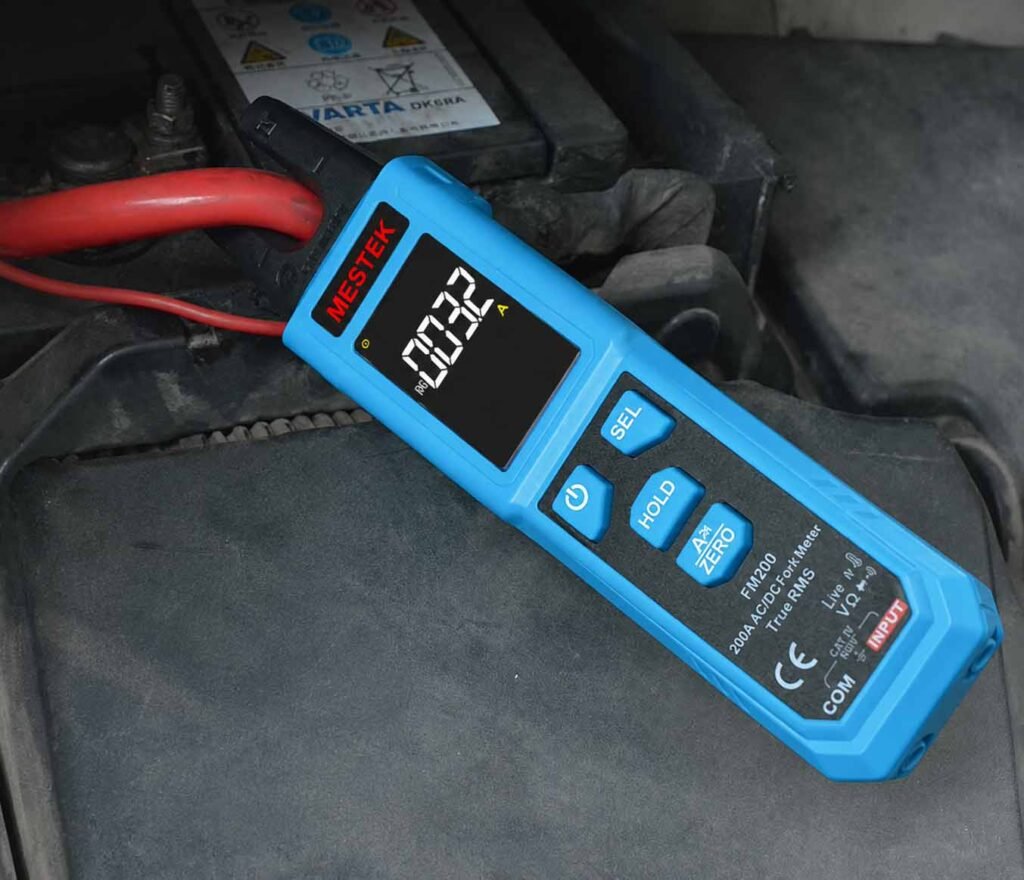
The MESTEK FM200 is designed as a compact fork meter for electricians and field testing. It provides AC/DC current measurement up to 200A, making it suitable for applications where the expected current is well below the 200A limit.
Its compact fork-style design can also be useful when working around crowded electrical panels or conductors where a larger clamp jaw would be inconvenient.
Consider a 200A meter when:
- You mainly perform low- to medium-current electrical work.
- You work in residential or light commercial environments.
- Portability and compact size are important.
- The equipment being tested has a known current well below 200A.
When Do You Need a 600A Clamp Meter?
A 600A clamp meter is a useful middle ground for general electrical testing.
It provides substantially more headroom than a 200A model without necessarily requiring the larger size and additional capability of a 1000A industrial clamp meter.
For electricians and maintenance technicians who work with a mixture of electrical panels, motors, machinery, and commercial equipment, 600A can be a practical range.

The MESTEK CM83A+ measures AC current up to 600A and has a 32mm jaw opening. It also provides voltage, resistance, capacitance, continuity, diode testing, NCV, and a built-in flashlight. Its safety rating is CAT III 600V.
The CM83A+ is a reasonable choice for general electrical maintenance work where a 600A range is sufficient.
A 600A clamp meter may be the right choice if you:
- Perform general electrical maintenance.
- Work with commercial electrical equipment.
- Test motors and electrical machinery within the meter’s current range.
- Need more capacity than a compact 200A meter.
- Want a general-purpose clamp meter rather than a specialized high-current instrument.
If your application involves unknown or potentially much higher current, however, a 600A meter may leave insufficient headroom.
When Should You Choose a 1000A Clamp Meter?
A 1000A clamp meter becomes more useful when you work with industrial equipment, larger conductors, motors, automotive systems, or other high-current applications.
The key advantage is not simply the larger number on the specification sheet. It is the additional measurement headroom.
For example, if a system normally operates around 500–600A but may experience significantly higher current during startup, a 1000A meter gives you considerably more room than a 600A model.
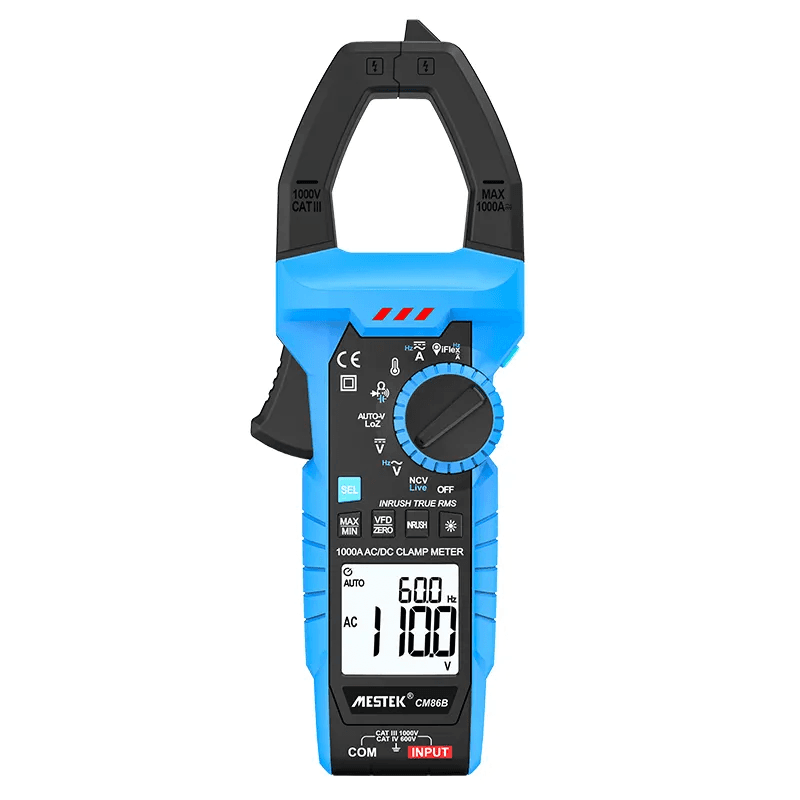
The MESTEK CM86B is one of the stronger choices in this range. It measures both AC and DC current through 60A, 600A, and 1000A ranges. It also supports 1000A inrush current measurement, has a 42mm jaw opening, True RMS measurement, and a CAT III 1000V safety rating.
The CM86B also supports an optional iFlex flexible clamp rated up to 3000A. This gives users a way to extend their current-measurement capability when working with larger conductors or applications that are difficult to access with a conventional clamp jaw.
A 1000A clamp meter is worth considering when you:
- Work with industrial machinery.
- Test motors or other high-current equipment.
- Measure larger electrical conductors.
- Need AC and DC current measurement.
- Need to measure startup or inrush current.
- Want additional headroom for future applications.
For professional users who work across different types of electrical systems, this additional flexibility can make a 1000A model a better long-term investment than a lower-range meter.
600A vs 1000A Clamp Meter: Which Should You Choose?
The decision between 600A and 1000A usually comes down to the maximum current you expect to encounter.
A 600A clamp meter is often sufficient for general electrical maintenance. If your applications rarely exceed several hundred amps, paying for a higher current rating may not provide a meaningful advantage.
A 1000A model becomes more attractive when your work involves industrial equipment, large conductors, motors, or unpredictable loads.
| Feature | 600A Clamp Meter | 1000A Clamp Meter |
| General electrical work | Excellent | Excellent |
| Residential applications | Excellent | More than necessary for many jobs |
| Commercial maintenance | Suitable | Suitable |
| Industrial equipment | Depends on application | Better suited |
| Large conductors | Limited by jaw size | Generally more suitable |
| High-current systems | Limited | Better choice |
| Inrush measurement | Model dependent | Often available on professional models |
| Future measurement headroom | Moderate | High |
Don’t Forget Inrush Current
Normal operating current is not always the highest current an electrical system experiences.
Motors, compressors, transformers, and other equipment can draw a substantially higher current when they start. This temporary surge is known as inrush current.
If you only choose a clamp meter based on the equipment’s normal running current, you may underestimate the measurement capability you actually need.
For example, a motor may operate within the range of a 600A clamp meter but produce a higher startup surge. In this situation, a meter with an appropriate inrush-current function and sufficient measurement capacity can be more useful.
The MESTEK CM86B supports inrush current measurement up to 1000A, making it suitable for applications where startup current is an important part of the test.
Does Jaw Size Matter When Choosing Current Range?
Yes. Current capacity is not the only specification you should consider.
A clamp meter measures current by placing its jaws around a conductor. If the conductor is too large to fit inside the jaw opening, a high current rating does not help.
For example, the CM83A+ has a 32mm jaw opening, while the CM86B provides a larger 42mm opening.
When choosing a clamp meter, therefore, consider both:
Current range + jaw opening
If you regularly work with large cables or busbars, also consider whether a flexible current probe would be more practical than a conventional clamp.
When Do You Need More Than 1000A?
Some industrial applications require current measurement beyond the range of a conventional clamp meter.
This is where flexible clamp accessories can be useful.
The MESTEK CM86B supports an optional iFlex flexible clamp with a measurement capability up to 3000A.
A flexible clamp can be particularly useful when:
- Conductors are too large for a standard jaw.
- Access around the conductor is restricted.
- You need to measure high current in crowded electrical cabinets.
- The application requires more than 1000A measurement capacity.
Rather than automatically buying a 3000A-capable solution, first determine whether your application actually requires that range.
AC or DC Current: Which Do You Need?
Another important consideration is whether you need to measure AC current, DC current, or both.
AC current measurement is common in household, commercial, and industrial AC electrical systems.
DC current measurement becomes important for applications such as:
- Automotive systems
- Battery systems
- Solar and photovoltaic equipment
- DC power systems
- Electronic equipment
For users who work across both AC and DC systems, an AC/DC clamp meter can eliminate the need for separate instruments.
For example, the CM86B supports both AC and DC current measurement up to 1000A.
How to Choose the Right Clamp Meter Current Range
Before purchasing, ask yourself these five questions:
- What is the highest normal operating current I expect to measure?
- Could the equipment produce a higher startup or inrush current?
- Do I need AC current, DC current, or both?
- Will the conductor fit inside the clamp jaw?
- Could my future applications require a higher current range?
If your answers point to relatively low-current applications, a 200A model may be sufficient.
For general electrical maintenance, 600A can provide a useful balance between capability and practicality.
For industrial, automotive, motor, and high-current applications, a 1000A clamp meter provides greater headroom. If your work goes beyond the limits of a conventional clamp jaw, a flexible current probe rated for higher current can be the better solution.
Recommended MESTEK Clamp Meters by Current Range
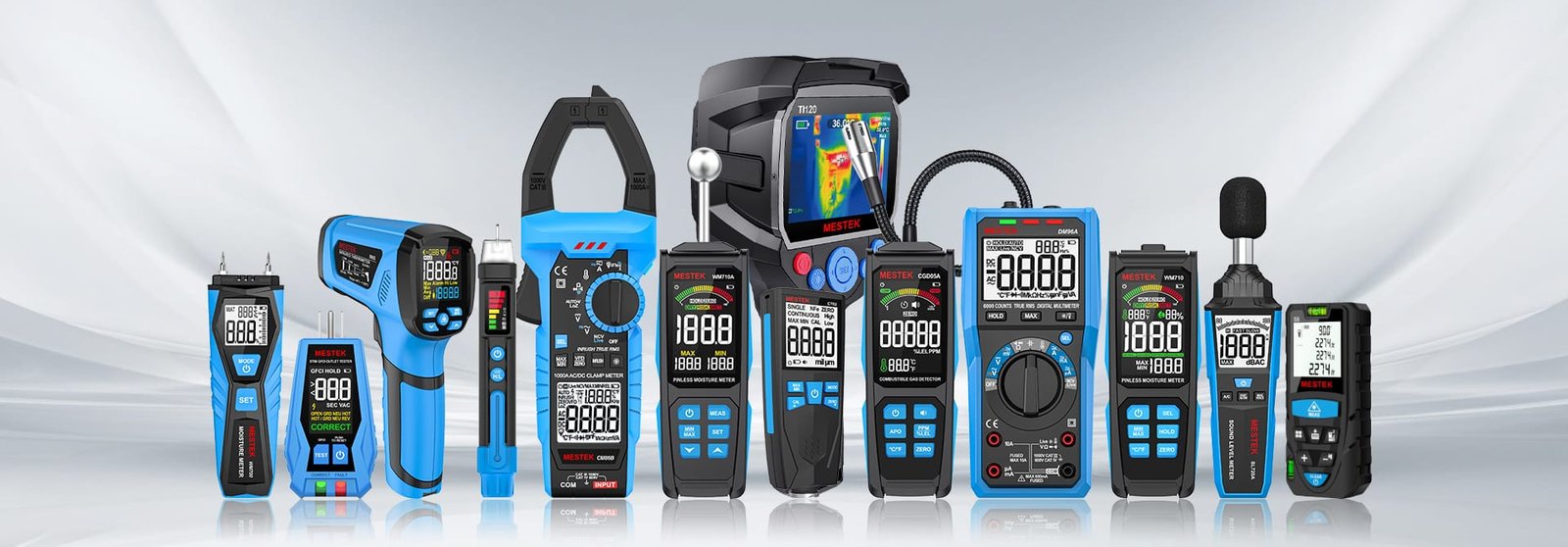
MESTEK offers several clamp meter options for different measurement requirements.
| Model | Current Capability | Best For |
| FM200 | Up to 200A AC/DC | Compact field testing and lower-current applications |
| CM83A+ | Up to 600A AC | General electrical maintenance |
| CM86B | Up to 1000A AC/DC | Industrial, automotive, and high-current testing |
| CM86B + optional iFlex | Up to 3000A | Specialized high-current applications |
The goal is not to select the largest number. It is to select enough capacity to safely and accurately handle your current measurement requirements while leaving reasonable headroom for unexpected or future applications.
Conclusion
The right clamp meter current range depends on the equipment you test and the type of work you perform.
A 200A clamp meter can be a practical choice for compact field testing and lower-current electrical work. A 600A clamp meter offers a good balance for general electrical maintenance. For industrial equipment, motors, automotive systems, and higher-current applications, a 1000A clamp meter provides more measurement headroom.
If you need to measure currents beyond 1000A or work around large conductors, a flexible current probe can extend the capability further. The MESTEK CM86B, for example, supports AC/DC current measurement up to 1000A and an optional iFlex solution up to 3000A.
Ultimately, choose your clamp meter based on maximum expected current, AC/DC requirements, inrush current, jaw size, and future measurement needs rather than simply choosing the highest amp rating available.