Selecting the right equipment is the heartbeat of every successful electronics project. Whether you are an engineer designing consumer tech or a hobbyist repairing a vintage radio, your power source is your foundation. A programmable DC power supply offers more than raw electricity. It provides safety, precision, and automation that a traditional bench power supply cannot match. This article explores the essential factors to consider when choosing the perfect unit for your laboratory. We will cover specifications, safety, and communication to help you make an informed investment.
What Is a Programmable DC Power Supply?
At its simplest, a programmable DC power supply is a device that converts AC electricity from your wall outlet into the specific DC voltage and current your electronic components need. However, unlike a basic adjustable DC power supply, where you manually turn knobs to guess at your settings, a programmable model offers digital control. You can set exact values via a keypad or, more importantly, through computer software.
The primary difference lies in flexibility and repeatability. A traditional bench power supply requires you to monitor the screen and adjust settings by hand. A programmable unit can store memory presets, execute timed sequences, and even be controlled remotely. This allows you to simulate real world battery drain, test how a circuit reacts to sudden voltage spikes, or automate long term stress tests without sitting at your desk for hours.
Key Factors to Consider When Choosing a Programmable DC Power Supply
When you start your commercial investigation into a new power source, the sheer number of specifications can feel overwhelming. Focusing on these three core areas will help you narrow down your search effectively.
Output Voltage and Current Range
The first question you must ask is: what are you powering? Every programmable DC power supply for electronics testing has a maximum voltage (V) and current (A) rating.
- Low Power Applications: If you primarily work with microcontrollers like Arduino or ESP32, a 0-15V or 0-30V range is usually plenty.
- High Power Applications: If you are testing automotive parts, industrial motors, or high power LEDs, you might need a supply capable of 60V, 100V, or even 20A.
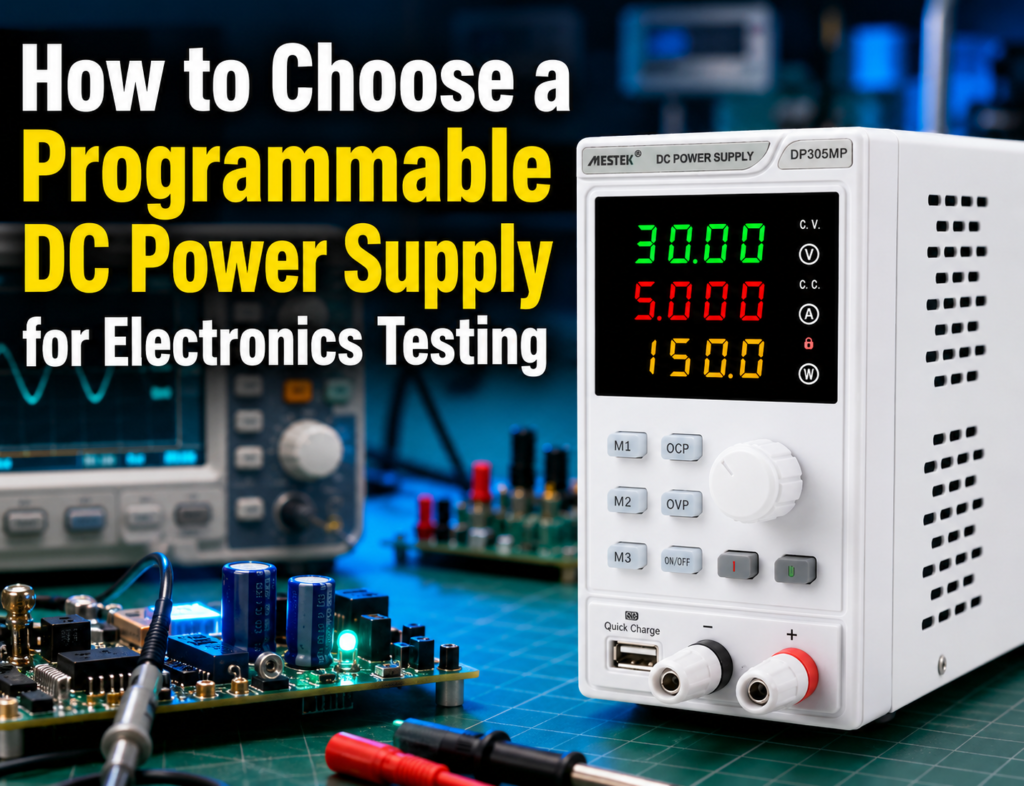
It is always wise to choose a supply that offers about 20% more range than your highest expected requirement. This “headroom” ensures that you aren’t running your equipment at its absolute limit, which improves longevity and stability. For example, the MESTEK DP305MP offers 0-30V and 0-5A, making it a versatile “sweet spot” for most general electronics repair and design tasks.
Accuracy, Stability, and Safety Features
Precision is the reason you buy a programmable unit. You want to ensure that when you set your supply to 5.00V, it delivers exactly 5.00V. Look for a unit with a 4-digit display, as this allows you to see small changes in current draw that could indicate a short circuit or a failing component.
Safety is equally critical. A high quality bench power supply should include:
- CV/CC Mode: Constant Voltage (CV) keeps the voltage steady while current fluctuates, and Constant Current (CC) keeps the current steady while voltage fluctuates. This prevents “blowing up” sensitive components.
- Over Voltage Protection (OVP): Automatically shuts off the output if the voltage exceeds a safe limit.
- Over Current Protection (OCP): Cuts power if the device under test attempts to draw excessive current.
- Low Ripple and Noise: Electricity is naturally “noisy.” A good supply filters this out, providing a clean signal that won’t interfere with sensitive signals in your PCB testing.
Communication and Control Options
The “programmable” part of the name comes to life through interfaces. While a coding switch on the front panel is great for quick adjustments, remote control is where the real power lies. Common interfaces include:
- USB: The standard for connecting to a PC for logging data or controlling the unit via simple software.
- RS232/RS485: These are industry standard protocols used in automated test systems. They allow multiple power supplies to be controlled by a single computer in a factory or large lab.
Having these options means you can write scripts to run “voltage sweeps,” slowly increasing power to find the exact point a component fails which is vital for professional product development.
Choosing a Programmable DC Power Supply for Different Applications
Different tasks require different strengths. Here is how to match your needs to the right tool:
- Electronics Repair: If you are fixing smartphones or laptops, you need high precision at low voltages. A 5V USB charging interface, like the one found on the DP305MP, is a lifesaver for testing if a phone’s charging circuit is functional.
- PCB and Circuit Testing: Here, stability is king. You need a supply that won’t fluctuate when you are measuring tiny signals on a new board.
- Laboratory Testing: For research, you need data logging. The ability to export your voltage and current readings to a computer via RS485 is essential for documenting your experiments.
- Product Development: You need the ability to simulate “dirty” power. A programmable supply can be set to drop voltage for a millisecond, mimicking a brownout, to see if your product reboots correctly.
Programmable DC Power Supply vs Adjustable DC Power Supply
Many beginners wonder if they should just buy a cheaper manual unit. While a basic adjustable DC power supply is fine for lighting up an LED, it lacks the protection and precision needed for modern electronics.
| Feature | Programmable DC Power Supply | Traditional Adjustable Power Supply |
| Control | Digital (Keypad/Software) | Analog (Manual Knobs) |
| Precision | High (4-digit+ display) | Moderate (3-digit display) |
| Remote Control | Yes (USB/RS232/RS485) | No |
| Memory Presets | Yes | No |
| Automation | Full (Scripts/Sequences) | None |
| Safety | Advanced OVP/OCP | Basic Fuses/Limiters |
Recommended Programmable DC Power Supply for Electronics Testing

If you are looking for a reliable, feature packed entry into the world of professional power, the MESTEK DP305MP is an excellent choice. It bridges the gap between affordable hobbyist gear and expensive industrial equipment.
This model is particularly popular for electronics testing and repair because of its integrated output switch. This allows you to set your voltage and current before you apply power to your circuit, preventing accidental damage. Its compact size and cooling efficiency make it a staple for any modern workbench.
MESTEK DP305MP Key Specifications:
- Voltage Range: 0-30V (Adjustable)
- Current Range: 0-5A (Adjustable)
- Display: 4-digit high resolution display
- Interfaces: Integrated USB, RS232, and RS485
- Special Features: Built in coding switch, independent output switch, and a dedicated 5V/1.5A USB charging port.
Conclusion
Choosing the right programmable DC power supply involves balancing your specific application needs with long term reliability. Focus on units that offer a high resolution 4-digit display, robust safety features such as CV/CC modes, and modern connectivity options such as USB or RS485. You ensure that your electronics testing is consistently accurate and safe by selecting a versatile model such as the MESTEK DP305MP. Investing in a high quality power source today is the best way to protect your sensitive components and accelerate your research projects for many years to come.