The global shift toward renewable energy has placed solar power at the forefront of modern infrastructure. The tools required to maintain them must also evolve as residential and commercial systems become more sophisticated. Choosing the right solar clamp meter is now a matter of safety and precision. Modern photovoltaic (PV) systems work at higher DC voltages than traditional circuits, often reaching 1000V. Standard electrical tools frequently lack the specialized ratings and DC measurement capabilities needed for these environments. This guide explains how to choose a solar clamp meter that ensures system efficiency and technician safety in any solar installation.
What Makes a Solar Clamp Meter Different?
At first glance, a photovoltaic clamp meter might look identical to the standard version found in a general electrician’s tool bag. However, the internal architecture and safety ratings are worlds apart. A standard clamp meter is often designed primarily for AC (alternating current) environments typical of household wiring. In contrast, a clamp meter for solar panels is engineered to handle the unique challenges of DC (direct current) generated by solar cells.
Higher DC Voltage Capability
Standard meters often top out at 600V. Modern solar strings, however, frequently reach 1000V or even 1500V DC. A specialized PV clamp meter is built to measure these high voltages without internal breakdown or risking an arc flash.
DC Current Measurement
While basic clamps use simple induction to measure AC, solar applications require Hall Effect sensors to accurately measure DC current flowing from the panels to the inverter. Without this, you cannot verify the output of individual strings.
PV Applications & Safety
Solar installations are “always on” during daylight hours. Unlike a building’s main breaker, you cannot simply “turn off” the sun. Therefore, the best clamp meter for solar installers must have superior insulation and safety ratings to handle live DC disconnects and high energy transients common in outdoor environments.
Key Features That Matter Most
When you are looking for the best clamp meter for solar installers, you shouldn’t just look at the brand name. Instead, focus on the technical specifications that will directly affect your ability to work safely and accurately.
1000V DC Voltage Measurement
Many residential and commercial PV systems operate at up to 1000V DC, while some large utility-scale installations may use 1500V DC systems. A meter rated for 1000V DC allows you to safely measure these high tension lines. Without this capacity, you risk blowing the internal fuses of the meter or causing an arc flash. This feature is essential for anyone commissioning new arrays or troubleshooting underperforming strings.
AC/DC Current Measurement
While the panels produce DC, the inverter converts it to AC. To diagnose the entire system, you need a meter that does both. Being able to measure up to 1000A AC/DC through the clamp jaw allows you to verify that the power being generated by the panels matches the power being sent to the grid or battery storage. Installers need this to ensure the system is balanced and that no specific cable is being over stressed by excessive current.
True RMS Technology
Inverters use high speed switching to convert DC to AC, which often creates “dirty” or non sinusoidal electrical waves. A standard “average responding” meter will provide inaccurate readings in these environments. True RMS technology allows the meter to calculate the actual heating value of the current, regardless of the waveform shape. This is non-negotiable for technicians working with modern high efficiency inverters where precision is the difference between a system pass and failure.
Power Measurement (KVA)
The ultimate goal of a solar installation is efficient power production. A clamp meter that can calculate power (kVA) allows technicians to quickly evaluate inverter output and overall PV system performance. By combining voltage and current measurements, the meter provides a practical snapshot of system operation, making routine inspections and troubleshooting more efficient.
CAT III 1000V Safety Rating
Safety should always be the priority when working with high energy systems. The CAT III 1000V rating means the meter is designed to protect the user against transients and surges in fixed installations, such as those found in solar combiner boxes and distribution panels. Anyone working on the “source side” of a PV system where the potential for high energy faults is greatest needs this level of protection to prevent catastrophic injury during a tool failure.
Jaw Opening and iFlex Options
Solar installations often involve thick, high gauge cables or crowded combiner boxes where a standard rigid jaw cannot fit. A large jaw opening (at least 40mm) is standard, but for the most difficult to reach cables, a flexible current probe (like an iFlex) is invaluable. This allows the technician to wrap a flexible coil around a large conductor or busbar, making current measurement possible in tight spaces where a traditional clamp simply won’t reach.
NCV & Inrush Current
Non Contact Voltage (NCV) detection allows for quick safety checks to see if a line is “live” without making physical contact. Inrush current measurement is equally important for solar systems that include motors, such as those used in solar tracking systems or cooling fans. When these motors start, they pull a massive spike of current. Measuring this spike ensures the breakers and wiring are correctly sized to handle the load without tripping.
How to Choose Based on Your Application
Different users have varying needs depending on the scale of the PV system they are servicing. Here is how to prioritize features based on your specific role:
Application Comparison Table
| Application | Recommended Voltage | Current Type | Key Features Needed | Priority |
| Residential Solar | 600V – 1000V DC | AC/DC | True RMS, NCV, Compact Design | Portability & Ease of Use |
| Commercial PV Systems | 1000V – 1500V DC | AC/DC | Power Measurement (KVA), Large Jaw | High Capacity & Safety |
| Solar Maintenance | 1000V+ DC | AC/DC | Inrush Current, Continuity, Temp Probe | Accuracy & Troubleshooting |
| General Electrical | 600V AC | AC Only | Resistance, Basic Voltage, Portability | Versatility |
For example, a residential installer might prioritize a compact design that fits in a tool belt. Whereas a commercial maintenance lead will require the highest safety ratings and the ability to measure power output at the transformer level.
Common Buying Mistakes
Many technicians, especially those transitioning from residential electric to solar, fall into the same traps. Avoid these four common mistakes:
- Choosing a Standard Clamp Meter: Using an AC-only clamp meter on a DC solar string will not provide an accurate DC current reading, making it impossible to properly diagnose PV system performance.
- Ignoring DC Current Capability: Some “budget” meters measure DC voltage but only AC current. For solar, you must have DC current measurement.
- Buying Based Only on Price: Cheap meters lack necessary shielding. In high-voltage environments, a cheap tool is a safety risk.
- Overlooking Safety Ratings: Never use a CAT II meter on a CAT III system. Always ensure a 1000V DC rating for strings.
- Paying for Features You Don’t Need: While iFlex clamps are great for 3000A loads, they may be unnecessary for basic residential string testing.
Recommended Solar Clamp Meter for Professionals
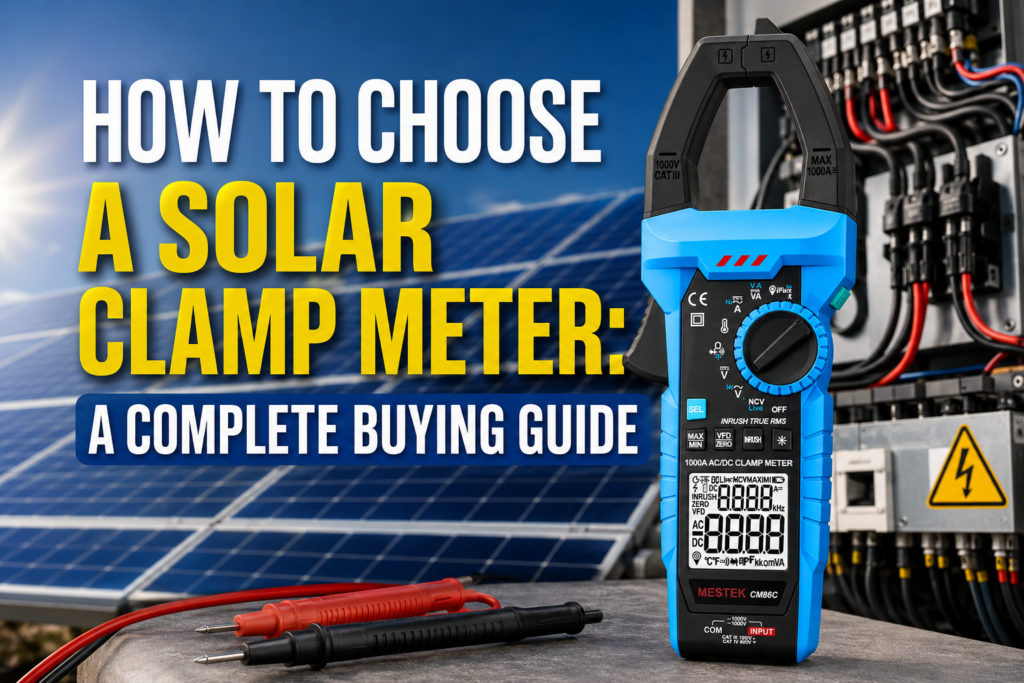
The MESTEK CM86C is a premier choice for those looking for a high performance tool. This meter is specifically engineered for the rigors of modern photovoltaic systems. One of the CM86C’s standout features is its dedicated 2500V photovoltaic DC voltage and 1000V photovoltaic AC voltage measurement capability. This enables installers to safely test high-voltage PV strings, combiner boxes, and inverter circuits during installation, commissioning, and maintenance. With its True RMS technology, it provides precise data for inverter inspection, ensuring AC output is clean despite switching noise.
For PV maintenance teams, the 42mm jaw opening easily accommodates thick gauge cables in combiner boxes. If you encounter larger conductors, the CM86C offers an optional 3000A iFlex flexible clamp for hard to reach spaces. Its ability to measure 2000KVA power and inrush current makes it an ultimate diagnostic tool for identifying system bottlenecks in any commercial PV system.
The MESTEK CM86C is best for:
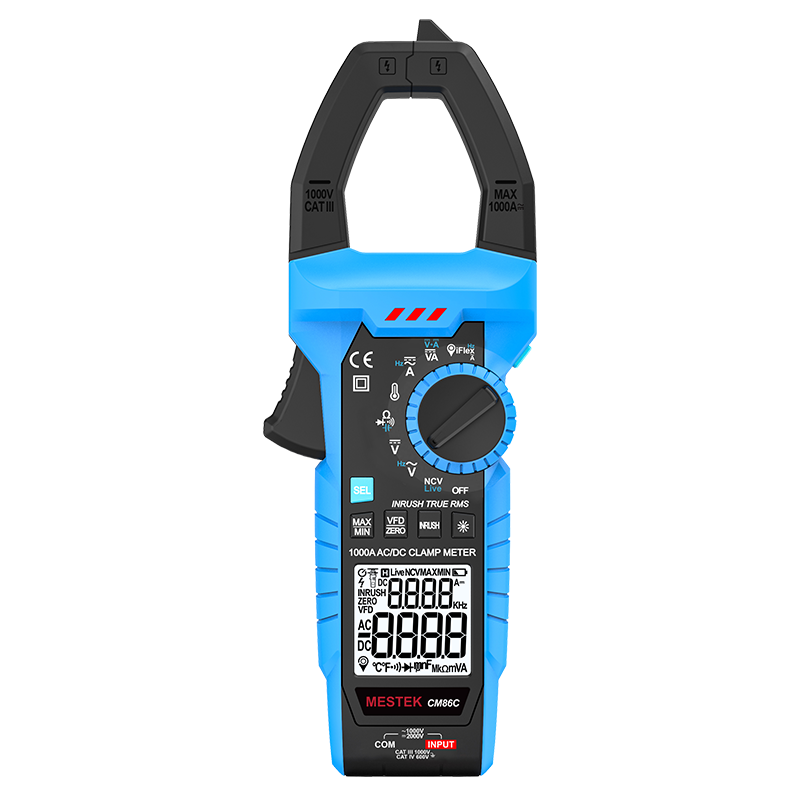
- Solar installers who need accurate AC/DC measurements during system installation and commissioning.
- PV maintenance technicians who troubleshoot solar systems and require inrush current and flexible clamp options.
- Inverter testing, thanks to its True RMS technology and precise electrical measurements.
- Residential and commercial solar projects, with a CAT III 1000V safety rating for added protection when working on high-voltage systems.
Check out the full specifications on the CM86C Product Page.
FAQs about Solar Clamp Meter
1. Can I use a regular multimeter for solar panels?
You can use a multimeter for voltage, but it is dangerous and difficult to measure current. You would have to break the circuit and run the high current DC through the meter. A clamp meter for solar panels is much safer, as it measures current through induction.
2. Why do I need to “zero” the meter for DC measurements?
Because DC measurements rely on the Earth’s magnetic field and surrounding electronics, the meter needs a baseline. Always press the “REL” or “ZERO” button before clamping onto a DC wire.
3. Is 600V enough for solar?
Usually, no. Most modern solar installations are designed in strings that push the voltage above 600V. Using a 600V meter on a 1000V system is a major safety hazard.
4. What does CAT III 1000V mean?
It is a safety rating. It means the meter is designed to protect the user against high voltage transients (surges) in fixed installations, such as the wiring between the panels and the inverter.
5. Can a clamp meter measure the power of a single panel?
Yes. You can determine its wattage by measuring the voltage and current of a single panel simultaneously. Some advanced meters like the CM86C can calculate this power automatically.
6. Do I need a flexible clamp?
If you work in tight spaces or with very thick cables, a flexible “iFlex” probe is much easier to use than standard hard jaws.
7. How do I test a solar panel with a clamp meter?
You can measure the Short Circuit Current (Isc) by clamping the meter around the positive lead while the string or panel is under load or shorted safely. Learn more in our guide on how to test a solar panel with a clamp meter.
8. Why do I need True RMS for solar?
Inverters convert DC to AC, often creating non-pure sine waves. True RMS meters are necessary to calculate the heating value of these signals accurately and avoid measurement errors.
Conclusion
Choosing the right solar clamp meter is about more than just getting a reading. It’s about safety, accuracy, and efficiency in a high voltage world. You ensure that your tool can handle the unique demands of photovoltaic systems by focusing on 1000V DC capabilities, True RMS, and a solid CAT III rating. Invest in a dedicated tool like the MESTEK CM86C to ensure your solar installations remain productive and, most importantly, safe for years to come.