Carbon monoxide (CO) is a dangerous gas that can build up indoors without warning. You cannot see it, smell it, or taste it. That is why every home with fuel burning appliances should have working carbon monoxide alarms. A portable CO detector can also help you check CO levels in different rooms.
Knowing how to check for carbon monoxide can help protect your family and keep your home safe. You can use household carbon monoxide alarms, portable CO detectors, and professional inspections to identify possible risks. This guide explains how to detect carbon monoxide in a house, measure its levels, and stay safe if CO is found.
Why Is It Important to Check for Carbon Monoxide?
CO forms when fuel does not burn fully. Common sources are gas furnaces, water heaters, fireplaces, wood stoves, gas ranges, boilers, and portable generators. A blocked chimney or vent can also let CO build up indoors.
CO is often called an “invisible killer” because it gives no clear warning. CO is hard to detect without a measuring device. Early exposure may cause headache, tiredness, dizziness, nausea, shortness of breath, or weakness. Severe exposure can cause confusion, unconsciousness, or death. Symptoms may look like the flu, but CO poisoning often occurs without a fever.
Every home should have working carbon monoxide alarms. The EPA recommends alarms on every level of the living space, near sleeping areas, and near an attached garage. Follow the alarm instructions and local building rules. See the EPA’s CO alarm guidance.
How to Check for Carbon Monoxide in Your Home
There are three main ways to check for CO at home.
1. Household CO alarms
A household carbon monoxide alarm is the first line of defense. It continuously samples the air and sounds an alarm when CO reaches a level and exposure time that meet its design settings. Some models show a warning light or digital reading. Others only show a status light and sound an alert.
Install alarms outside each sleeping area and on every level of the home, following the product instructions and local rules. If you have an attached garage or fuel burning appliance, CO alarms are especially important. Test each alarm on the schedule recommended by the manufacturer. Replace batteries when needed, and replace the alarm when it reaches the end of its service life.
A CO alarm is designed to warn people during a developing hazard. It is not the same as a laboratory instrument. Some alarms do not show the exact CO concentration.
2. Portable CO detectors
A portable CO detector, also called a carbon monoxide monitor or CO meter, measures the gas in the air around it. Many handheld meters display the result in parts per million, or ppm. This gives you more information than a simple alarm tone.
A portable meter can be useful when you want to check several rooms, investigate a suspected appliance problem, or look for changes near a furnace room, fireplace, or water heater. It can also help technicians and building managers during routine checks. Still, it should support, not replace, proper household CO alarms.
3. Professional inspection
A detector can tell you what is happening in the air at one moment. It may not explain why CO is present. A qualified heating or gas professional can inspect burners, heat exchangers, flues, chimneys, vents, and combustion air. Regular service can find problems before they create a serious indoor hazard.
How to Check CO Levels in a House
If you want to know how to test for carbon monoxide at home with a portable meter, use these basic steps. Always read the instrument manual first.
- Start the detector in fresh air. Turn it on outside or in a clean area, if the manual allows this. Check the battery status. Wait for the startup process to finish. Do not begin a test while the screen is still warming up or calibrating.
- Choose a sensible measurement location. Move through rooms that contain fuel burning appliances. Check near, but not directly against, a furnace, water heater, fireplace, or stove. Also check sleeping areas and rooms next to an attached garage. Keep the sensor away from water, dust, direct heat, and strong airflow unless the manual says otherwise.
- Hold the meter at breathing height. CO mixes with indoor air. You do not need to place the meter on the floor or ceiling. Hold it where people normally breathe, and avoid covering the sensor openings.
- Allow the reading to settle. Stay in each location long enough for the number to respond. The required time depends on the instrument and its manual. For routine checks, record the room, time, and reading. A low result in one room does not prove that every room is safe.
- Compare rooms and repeat the check. Take readings in more than one location. If CO appears near an appliance or rises when the appliance runs, stop using the appliance if it is safe to do so and arrange a professional inspection.
Consider MESTEK Portable CO Detectors
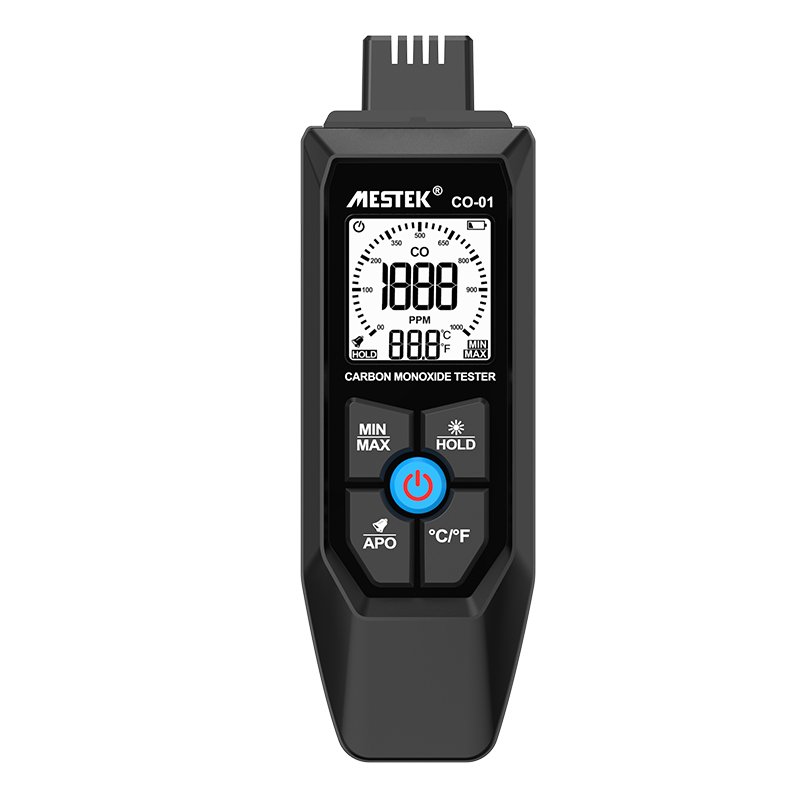
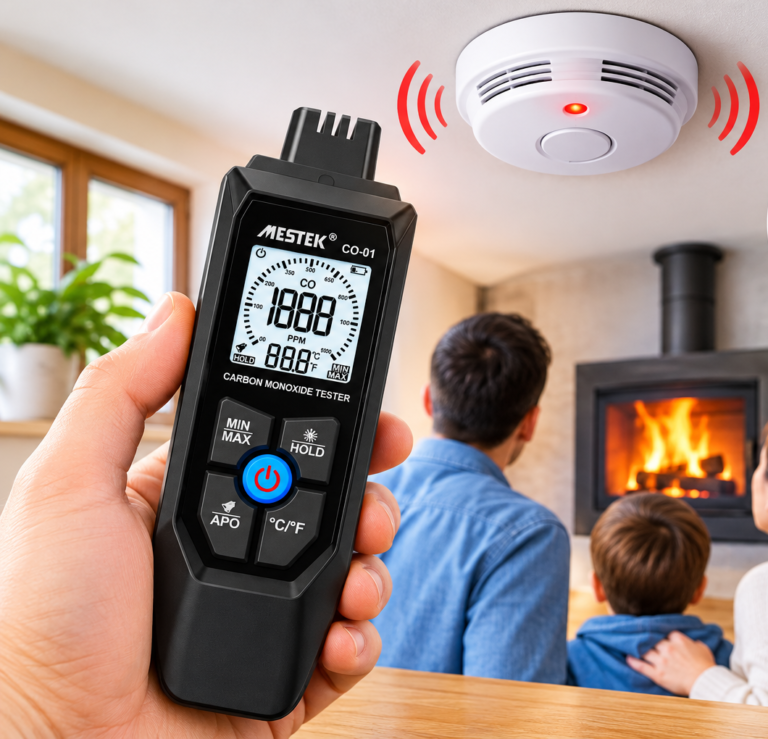
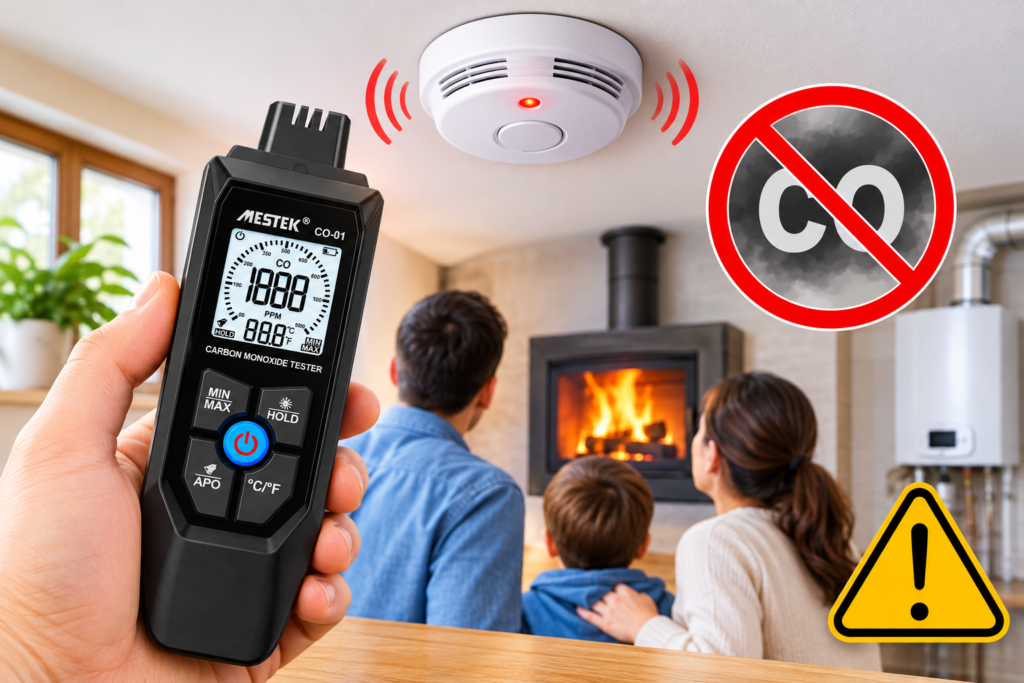
If you need a handheld device for routine CO checks, consider the MESTEK Portable CO Detector CO-01. It is designed to measure carbon monoxide levels in indoor environments from 0 to 1000 ppm, with 1 ppm resolution. It uses diffusion sampling to measure the surrounding air without an external pump.
The device also includes an LCD screen, audible and visual alarms, and up to six years of sensor life. This portable CO detector helps users monitor carbon monoxide concentrations during routine indoor air checks and inspections.
Remember that a portable measuring instrument is not a replacement for a certified household CO alarm.
What Should You Do If Carbon Monoxide Is Detected?
If a carbon monoxide alarm sounds, or if you suspect exposure:
- Leave the building immediately. Take everyone and pets outside if you can do so quickly and safely.
- Call emergency services from outside. Tell them that you suspect carbon monoxide. Follow the instructions from responders.
- Do not search for the source first. Do not spend time opening windows, checking appliances, or finding a portable meter.
- Also, do not ignore symptoms. Anyone with headache, dizziness, nausea, confusion, weakness, or breathing trouble should receive urgent medical advice.
- Do not re-enter. Wait outside until firefighters, emergency workers, or a qualified professional says it is safe.
- Have the source repaired. Do not restart a furnace, water heater, fireplace, or other appliance until it has been checked.
Never silence an alarm and assume the problem is solved. Fresh air may lower the reading for a short time, but the source may still be active.
Carbon Monoxide Alarm vs. Portable CO Detector
Both devices help detect carbon monoxide, but they serve different purposes. Understanding the difference can help you choose the right equipment for your home.
| Feature | Household CO Alarm | Portable CO Detector |
| Main purpose | Warn occupants of CO danger | Measure CO concentration |
| Display | Often alarm only | Usually digital display |
| CO readings | Usually no continuous ppm display | Displays readings in ppm |
| Portability | Usually fixed in one location | Easy to carry |
| Best use | Household protection | CO measurement and inspection |
The two devices work well together. Keep certified household CO alarms installed, then use a portable carbon monoxide detector when you need more detail. For example, a meter can help you compare a boiler room with a hallway, but it should not be used to delay an evacuation.
FAQs
1. How can you tell if carbon monoxide is present in your home?
Use a working carbon monoxide alarm or a suitable portable CO detector. You cannot reliably detect CO with your senses. Headache, dizziness, nausea, and unusual tiredness can be warning signs, but symptoms alone cannot confirm the gas is present. If an alarm sounds or symptoms appear, go outside and call for help.
2. Can you test for carbon monoxide without a detector?
No. You cannot reliably test for CO using your senses or household remedies. If you suspect a leak, leave the building and contact emergency services or a qualified technician.
3. Does a carbon monoxide alarm show the actual CO level?
Not always. Many household alarms sound when CO meets their alarm criteria but do not display a live ppm value. A digital alarm may show a recorded peak, while a portable CO monitor is generally better suited to current measurements. Check the product manual.
Conclusion
The safest way to check for carbon monoxide is to use household CO alarms, test them regularly, and maintain fuel burning appliances. A portable CO detector can add useful ppm readings during room by room checks, but it does not replace emergency alarms or professional inspection. If an alarm sounds or someone feels ill, leave immediately and call emergency services. For users who need portable measurements, MESTEK portable CO detectors offer a compact option for routine CO checks.