When selecting a digital clamp meter, one of the most important yet overlooked specifications is the clamp meter jaw size. This physical dimension determines the maximum thickness of the conductor you can measure safely and accurately. Choosing the wrong size can lead to inaccurate readings or an inability to fit the tool around the target wire. Understanding how to match the jaw opening to your specific electrical tasks is essential for safety and professional efficiency. This guide explores how to choose the right clamp meter jaw size for your needs.
What Is Clamp Meter Jaw Size?
The clamp meter jaw size, or clamp meter jaw opening, is the maximum physical distance the transformer jaws can spread to enclose a conductor. This measurement is not just the internal diameter when closed. It represents the space required to clear the cable during clamping. It matters because the measurement principle relies on electromagnetic induction, which requires the jaws to close fully around a single conductor to form a magnetic circuit.
When considering jaw size, remember you are not just measuring the metal core. The cable’s overall outside diameter (OD), including insulation and shielding, must be accommodated. Clamping onto a wire where the jaws cannot fully meet results in measurement errors and potential insulation damage. Thus, the jaw must comfortably fit the thickest insulated cable in your work environment.
How to Choose the Right Clamp Meter Jaw Size
Choosing the right clamp meter jaw size requires a pragmatic approach based on your electrical tasks.
1. Measure the Outside Diameter
Before purchasing, identify the largest cables you expect to test. Use a caliper or a diameter tape to measure the outside diameter of these conductors. Remember to measure the thickest part, including all layers of insulation and any protective jacketing. If the cable is 30 mm thick, a 22 mm jaw will be physically unable to perform the measurement, regardless of the meter’s electrical capacity.
2. Leave Enough Clearance
A common mistake is choosing a jaw size that exactly matches the cable diameter. However, for a clamp meter to function accurately and safely, the jaws must close properly without being forced. Selecting a jaw size that provides a few millimeters of clearance ensures that the conductor sits centrally within the magnetic loop, which is essential for minimizing measurement errors.
3. Consider the Working Environment
The physical space available around the conductor is just as important as the conductor itself. In a densely packed breaker panel or a tight junction box, a large, bulky clamp meter may not fit between adjacent wires. In these scenarios, a compact tool with a smaller jaw is often more effective than a high-capacity industrial model.
4. Remember That Bigger Is Not Always Better
While it might seem logical to buy the largest possible jaw to cover all scenarios, this often results in a tool that is heavy, cumbersome, and difficult to maneuver. Larger jaws are typically attached to larger meter bodies, which can be a disadvantage when working in confined spaces. The goal is to match the tool to the specific scale of your electrical work.
Common Clamp Meter Jaw Sizes and Their Applications
Different jaw sizes are designed for different working conditions. The ranges below can help you identify the right option for your needs.
1. 20–25 mm Jaw
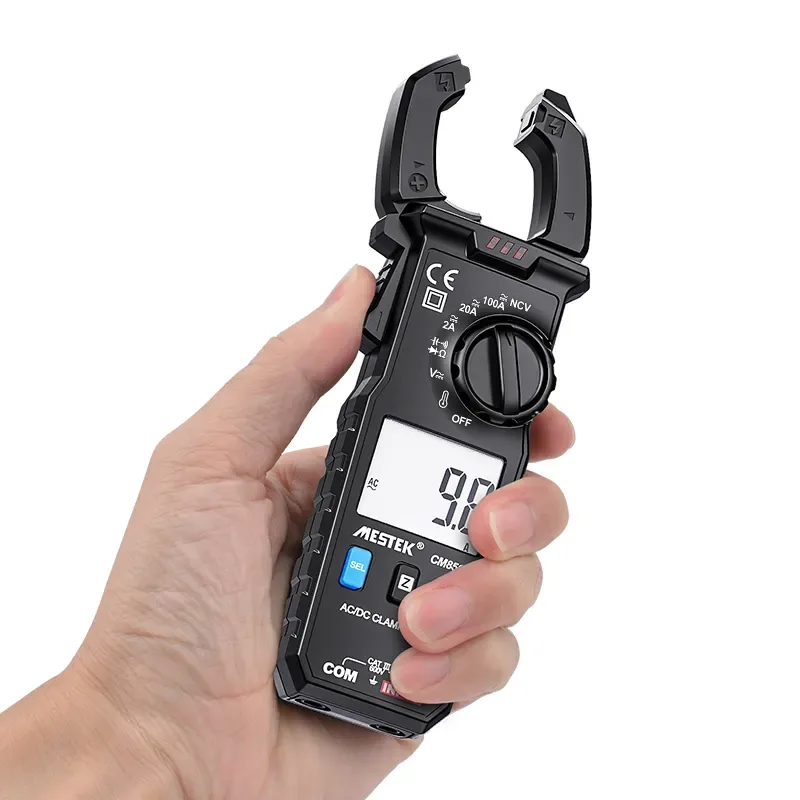
A 20–25 mm jaw is suitable for smaller wires, branch circuits, appliance wiring, and tight spaces. Its compact profile helps technicians reach a conductor without moving nearby wires. It is a practical choice for portable service work when current requirements are moderate.
The MESTEK CM85C Mini Clamp Meter is a compact example. Its product overview lists a 22 mm jaw opening, True RMS measurement, K-type temperature testing, and zero-clearing functions. Its listed AC and DC current range reaches 100 A, so it suits smaller circuits rather than heavy industrial cables.
2. Around 30–32 mm Jaw
A jaw opening around 30–32 mm is a useful middle ground for general electrical maintenance. It can accommodate many small to medium sized cables used in residential, commercial, HVAC, and facility service work while remaining manageable in confined areas.
The MESTEK CM83A+ is a 32 mm jaw clamp meter with a listed AC current range up to 600 A. It also includes a 6000 count, flashlight, and non contact voltage detection. Compare the jaw opening with the cable’s outside diameter before purchase.
3. Around 40–42 mm Jaw
A 40–42 mm jaw is more suitable for larger cables, motors, battery systems, solar equipment, and industrial applications. It provides more room around thick insulated conductors, although the meter may be larger and less convenient in confined panels.
The MESTEK CM86C Solar Clamp Meter has a 42 mm jaw opening and is designed for photovoltaic installation and maintenance. It lists AC/DC measurement up to 1000 A, True RMS, inrush current, and PV voltage functions. Check that its voltage and CAT rating suit the environment.
4. Flexible Clamp for Large or Difficult-to-Reach Conductors
A flexible clamp is useful when a rigid jaw cannot reach a conductor directly. The flexible sensor can be routed around large cables, busbars, or conductors in crowded cabinets. This is helpful when cables cannot be moved or there is not enough room to open a traditional jaw.
The MESTEK CM86B and CM86C support an optional 3000 A iFlex flexible clamp. The CM86B lists AC/DC current ranges up to 1000 A and the optional flexible accessory. The CM86C combines a 42 mm rigid jaw with the same optional iFlex option. Use the rigid jaw for accessible conductors and the flexible clamp for large or difficult to access cables.
Clamp Meter Jaw Size vs. Current Range
It is a misconception that jaw size is directly linked to current capacity. While larger jaws often accompany higher ratings, you must distinguish between the physical jaw opening and the electronic current measurement range. The opening is a mechanical limit of the maximum thickness a wire can be. The current range is an electronic limit of how much amperage the internal sensors can process.
For example, a meter might have a large 42 mm jaw but only be rated for 600A. Conversely, a compact meter might have a smaller jaw but high sensitivity. A larger physical opening does not guarantee a higher amperage capability. Check both specifications before choosing a clamp meter. Ensuring the tool matches both the wire diameter and the expected current load is the only way to ensure safe operation.
Does a Larger Clamp Meter Jaw Mean Better?
Is a larger jaw always superior? No. A larger clamp meter jaw is better only when your conductors need it. Oversizing can add weight and make positioning more difficult. Smaller jaws can be easier to center around smaller conductors and simpler to carry all day.
Choose a jaw with comfortable clearance over your largest regular cable. If your work covers many cable sizes, consider a suitable rigid jaw meter with a flexible accessory instead of one oversized tool.
How to Choose the Right Clamp Meter
Consider these recommendations based on your primary field of work:
- 22 mm Jaw: Small wires and compact spaces. The CM85C is the best compact option.
- 30–32 mm Jaw: General residential and commercial electrical tasks. The CM83A+ serves this segment well.
- 40–42 mm Jaw: Larger cables and industrial applications. The CM86B and CM86C are excellent industrial grade choices.
- Flexible Clamp: Massive conductors or difficult-to-access wiring. The iFlex option for the CM86 series is essential.
Jaw size is only one buying factor. Also review current range, AC/DC capability, accuracy, CAT rating, True RMS, inrush measurement, display resolution, and weight. True RMS can help with variable or non-linear loads. Select a CAT rating for the measurement environment and follow the manufacturer’s instructions.
Choose according to your cables, access conditions, and electrical system. Explore MESTEK Clamp Meters today to find a tool that fits your work.
Conclusion
Choosing the right clamp meter jaw size is fundamental for safety and efficiency. You can choose a tool that provides accurate readings without hindrance by understanding the relationship between cable diameter, insulation, and workspace constraints. Whether you need a compact 22 mm meter or a high capacity flexible clamp, matching the jaw to the application is key to professional success. Investing in quality instrumentation pays off through reliable data and long term durability.