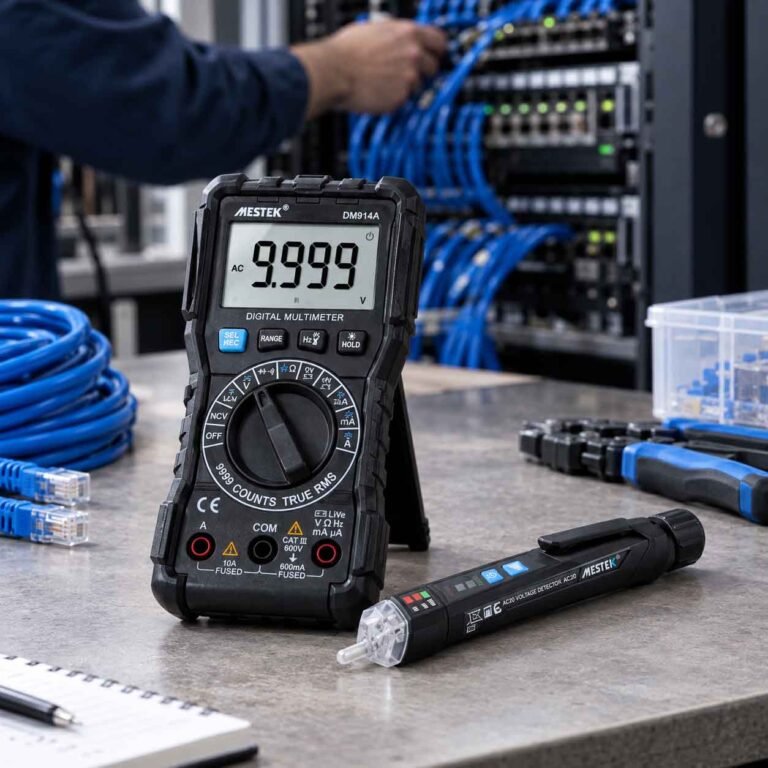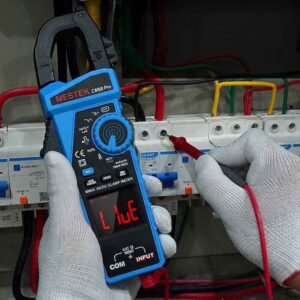
Relays are small but essential components used in cars, appliances, HVAC systems, industrial equipment, and countless electronic devices. Their job is simple: they use a low power signal to safely and efficiently control a higher power circuit. Because relays switch electrical loads, they experience wear over time. Burnt contacts, damaged coils, or internal mechanical failure can cause them to stop working correctly.
When a device suddenly stops turning on or won’t turn off, a faulty relay is often the cause. Fortunately, diagnosing a relay is not complicated. A digital multimeter is the easiest and most reliable tool for checking relay health. This article explores how to test a relay with a multimeter and how to check the contacts using simple resistance and continuity measurements.
What Is a Relay and How Does It Work?
A relay functions as an electrically operated switch that controls electrical circuits through electromagnetic action. It allows a small electrical signal to maintain a larger circuit, which is why relays are common in cars, appliances, and control panels.
The Two Main Parts: Coil and Contacts
The relay consists of two primary components that work together.
- First, the coil acts as an electromagnet that generates a magnetic field when current flows through it.
- Second, the contacts serve as physical switches that open or close circuits.
Furthermore, these components remain electrically isolated from each other. It allows a low power signal to safely control a high power circuit.
Normally Open (NO) vs Normally Closed (NC)
Relays typically include these contact types:
- Normally Open (NO): When the relay is not energized, the NO contact is open (no connection). When the coil is powered, the NO contact closes and connects to the common terminal.
- Normally Closed (NC): When the relay is not energized, the NC contact is closed (connected). When the coil is powered, the NC contact opens and disconnects.
What Happens When the Coil Is Energized?
When voltage is applied to the coil, it creates a magnetic field that attracts the movable armature. This mechanical movement changes the state of the contacts, closing NO contacts and opening NC contacts. After power removal, a spring returns everything to its original position.
What You Need to Test a Relay

- Digital Multimeter (DMM) The modern digital multimeter is preferred over older analog models for its precision and auto ranging capabilities. Your multimeter must have these essential functions:
- Resistance (Ohms) Mode for checking the health of the relay’s internal coil
- Continuity Mode to verify if contacts are opening and closing correctly (typically indicated by an audible beep)
- DC Voltage Measurement for checking the voltage across the terminals
- Diode Test Mode is especially important for relays with built-in flyback diodes that suppress voltage spikes
- The Relay is either removed from the circuit for bench testing or accessible in its installed location
Safety Precautions Before Testing a Relay
Safety should always take priority when testing relays with a multimeter. Proper precautions prevent electrical shocks, equipment damage, and inaccurate readings.
1. Always Disconnect Power
Prior to handling any relay, completely disconnect it from its power source. For automotive applications, this means removing the related fuse or disconnecting the battery.
In household or industrial settings, turn off the circuit breaker first, then verify with a voltage tester that no current remains in the circuit. This step is non-negotiable. Even low voltage systems can cause injuries or damage sensitive multimeter components.
2. Why testing a live relay is dangerous
Testing an energized relay presents several hazards. First, the risk of electrical shock increases significantly, particularly with relays controlling high current circuits. Moreover, accidental shorts while probing can damage both the relay and connected components.
Another critical concern is that live testing may produce misleading readings, as external voltage affects multimeter measurements, potentially leading to incorrect diagnoses.
3. Bench Testing vs In-Circuit Testing
Bench testing involves removing the relay completely from its circuit for isolated examination. This method provides the most accurate results since no external components interfere with readings.
In contrast, in-circuit testing examines the relay while still installed but de-energized. This approach might be affected by parallel circuits or components, though convenient. For accurate results, especially when learning how to check a relay, bench testing is strongly recommended.
How to Test a Relay with a Multimeter

Testing a relay follows a logical sequence of steps using a digital multimeter. This straightforward process will help identify common relay problems through electrical measurements.
Step 1: Identify Relay Pins (Coil, COM, NO, NC)
First, locate the pin identification numbers typically printed on the relay case. Most automotive relays follow the standard DIN numbering system, where:
- 85 & 86: Control coil terminals (input)
- 30: Common terminal (COM)
- 87: Normally Open terminal (NO)
- 87a: Normally Closed terminal (NC) (if present)
Pin identification is crucial as incorrect probe placement leads to inaccurate diagnosis. For unlabeled relays, consult the manufacturer’s datasheet or use the multimeter itself to identify the coil pins they’ll show resistance between them).
Step 2: Test the Relay Coil Resistance
Set your multimeter to resistance (Ω) mode. Place one probe on pin 85 and the other on pin 86. A healthy 12V relay coil typically reads between 50-120 ohms.
An “O” (over limit) reading indicates an open/broken coil, hence a failed relay. Conversely, a near zero reading suggests a short circuit in the coil, which also requires replacement.
Step 3: Perform a Continuity Test on the Contacts
Switch your multimeter to continuity mode. For a normally open relay, test between pins 30 and 87. You should get no continuity (no beep).
Between pins 30 and 87a (if present), you should have continuity. Once the relay is energized, these readings reverse as the internal switch changes position.
Common Mistakes When Testing a Relay
Even experienced technicians make errors when testing relays. Here are common errors to avoid.
1) Testing without identifying pins
Many troubleshooting attempts fail immediately due to incorrect pin identification. Without proper terminal identification, readings become meaningless.
For unlabeled relays, use the multimeter’s resistance mode to identify coil terminals first. They typically show 50-100 ohms of resistance between them. The other terminals are contact pins.
2) Using the wrong multimeter mode
Selecting inappropriate measurement settings frequently leads to inaccurate results. Coil testing requires resistance mode (ohms), whereas contact testing demands continuity mode.
Using voltage measurement when checking resistance yields misleading readings. Importantly, some tests require the relay to be energized with the correct voltage while measuring across specific pins.
3) Assuming all relays are the same
Different relay types feature varying pin configurations, voltages, and contact arrangements. The assumption that all relays follow identical specifications creates confusion.
Some relays use normally closed contacts while others use normally open contacts as their default state. Pin numbering systems may differ between manufacturers or applications.
4) Ignoring relay specifications
Datasheets contain critical information that cannot be overlooked. Operating outside recommended parameters drastically reduces relay lifespan.
Key specifications include maximum switching voltage, minimum switching voltage, switching current capacity, and coil voltage requirements. Ignoring these values leads to premature failures and potentially damaged circuits.
Can a Relay Be Bad Even If It Passes a Multimeter Test?
Yes, multimeter testing has limitations. A relay that passes basic electrical tests can still be problematic in actual operation for several reasons.
- Burnt Contacts: Over time, switching creates small electrical arcs that slowly burn and pit the contact surfaces. A multimeter may still show continuity, but the damaged contacts can develop resistance and fail under high current or inductive loads.
- Intermittent Failure: Some relays work during testing but fail randomly in actual use. Heat, vibration, or loose internal connections can cause inconsistent performance that bench testing cannot easily reproduce.
- Mechanical Wear: Relays are mechanical devices, so physical damage or wear may not show up electrically. Drops, misalignment, weak springs, or moisture intrusion can lead to failure even after the relay passes a digital multimeter relay test.
This is why sometimes further diagnostics are needed even after a successful digital multimeter relay test.
FAQs about How to Test a Relay with a Multimeter
1) Can you test a relay without power?
Yes. You can test coil resistance and contact continuity without powering the relay. This is the safest method for basic diagnosis.
2) What does OL mean when testing a relay?
“OL” means “Open Loop” or “Over Limit.” It usually shows up when the relay coil is broken inside. This means the coil has infinite resistance and the relay needs to be replaced.
3) Can a relay click and still be bad?
Yes. A clicking sound only means the coil is working and the internal armature is moving. The contacts inside may still be burnt, damaged, or not make proper electrical contact. Always perform a continuity test to confirm the relay is working correctly.
4) How do you test an automotive relay?
Automotive relay testing uses the same steps:
- Measure resistance between pins 85–86.
- Perform a relay continuity test between 30–87 and 30–87a.
- Optionally energize the coil with 12V and check if the contacts switch properly.
5) Do all relays have the same pin layout?
No. While many automotive relays follow standard numbering, industrial relays vary. Always verify the diagram before performing relay testing with a multimeter.
Conclusion
A proper digital multimeter relay test helps you confirm whether the coil is intact and whether the NO and NC contacts switch correctly. With the right approach, relay testing saves time, prevents unnecessary part replacements, and reduces misdiagnosis in electrical systems. Relays may be small, but testing them properly makes a big difference in reliable repairs.