Because wind affects safety and performance in numerous areas, accurately measuring it is crucial. That’s where an anemometer comes in. An anemometer is the standard tool used to measure wind speed and, in many cases, wind direction as well. This article explores what an anemometer is, how it works, the different types you’ll see today and how to choose the right one for your needs.
What is an Anemometer, and How Does it Work?
An anemometer is a device used to measure wind speed and in many modern models, wind direction and air pressure as well. It’s one of the most important tools in meteorology, aviation, construction and any industry where airflow is critical. The term “anemometer” comes from the Greek word anemos, meaning wind. The earliest known anemometers date back to the 15th century.
An anemometer works by responding to the movement of air and converting that motion into measurable data. This may involve mechanical rotation, such as spinning cups or a propeller, or electronic changes in heat, sound waves or light as air flows past a sensor, depending on the type of anemometer.
The device then processes this information and displays wind speed (and sometimes direction or pressure) on a digital screen or an analog dial, giving the user real time insights into wind conditions.
Why Wind Speed Measurement Matters
Wind may seem like a natural force we can’t control but measuring it helps us predict, prevent and protect in many industries. Accurate wind speed data is important for:
- Weather forecasting and storm prediction
- Aviation safety and runway decisions
- Construction-site crane and scaffold safety
- Wind farm planning and turbine performance
- Marine navigation and offshore operations
- HVAC testing and ventilation balancing
- Environmental monitoring and pollutant tracking
- Sports, hiking, sailing and outdoor planning
In some cases a small difference in wind speed can mean the difference between safe operation and serious risk.
Types of Anemometers Explained
There are many types of anemometers, each for a specific environment or accuracy level. Here are the most common:
1) Cup anemometers
The most common type has three hemispherical cups mounted on horizontal arms attached to a vertical shaft. As the wind pushes the cups, their rotation speed is directly proportional to wind velocity. Originally with four cups, the three-cup design became standard thanks to Patterson, who proved it was faster and had more aerodynamic torque. This robust, low maintenance design is the industry standard for meteorological stations and wind energy assessments.
2) Vane or propeller anemometers
These look like small windmills and measure wind by counting propeller rotations per time unit. Unlike cup anemometers with vertical rotation axes, vane anemometers have horizontal axes that must be parallel to wind direction. They are more accurate at lower wind speeds but require proper alignment to avoid measurement errors above 20 degrees of misalignment.
3) Hot-wire anemometers
These use a fine wire (several micrometers in diameter) heated above ambient temperature. Air flowing past cools the wire, changing its electrical resistance in proportion to the wind speed. They’re very sensitive and fragile but have high frequency response and fine spatial resolution making them ideal for studying turbulent flows.
4) Ultrasonic and acoustic resonance anemometers
Ultrasonic devices measure wind velocity based on sound wave travel time between transducer pairs. With no moving parts these anemometers require minimal maintenance and work in harsh environments. Acoustic resonance variants invented by Savvas Kapartis in 1999 create resonating ultrasonic waves within small cavities and measure phase shifts caused by wind.
5) Pressure-based anemometers
These instruments measure wind speed through pressure differences. Traditional designs include plate anemometers (using wind deflection of flat plates) and tube anemometers (measuring pressure differences in specially arranged tubes). Modern pressure anemometers convert air pressure readings into wind speed data for applications from weather forecasting to industrial safety.
6) Laser Doppler anemometers
This advanced technology uses laser beams to detect air movement. When particles in airflow pass through intersecting laser beams, they create light scatter patterns. The Doppler shift in these patterns is directly proportional to flow velocity. These non-intrusive instruments are great for measuring velocity in transparent fluids or surface vibrations without disturbing the flow.
Wind Speed Measurement Units
Wind speed can be measured in different units depending on the region or industry. Most anemometers allow you to switch between:
- Meters per second (m/s) – common in science and meteorology
- Kilometers per hour (km/h) – common in general weather reporting
- Miles per hour (mph) – mostly used in the U.S. and some other regions
- Knots (kt) – standard for aviation and marine navigation
- Feet per minute (ft/min) – often used for ventilation and HVAC
In meteorology, wind speed is typically measured at 10 meters above ground to standardize global readings.
How to Use a Handheld Anemometer
Handheld anemometers are easy to use but correct technique makes readings more reliable.
Tools you’ll need: A handheld anemometer is sufficient. To calculate airflow volume, the duct size or area is needed to convert air velocity into CFM or CMM.
Step 1: Power On and Set Your Units
Turn on your handheld anemometer and select your preferred measurement unit, whether that’s m/s, km/h, ft/min, knots or mph. Choose the standard that matches your location or job and confirm on the display before measuring.
Step 2: Position the Sensor Correctly
Point the sensor directly into the airflow to get accurate readings. For outdoor use, aim the vane straight into the wind; for HVAC ducts or vents, align it so air hits the vane head-on. Keep it square to the airflow, as even a 15-20° tilt can affect accuracy, especially at lower airspeeds.
Step 3: Let the Reading Stabilize
Hold the device steady for a few seconds to let the reading settle. MESTEK AM-series meters sample the air multiple times per second, delivering smooth, stable results once the airflow becomes consistent.
Step 4: Check Different Measurement Modes
For a complete picture of the airflow, review the instant (real-time) speed, the maximum speed and the average speed. Professionals often use all three values together to compare gusts, variations and overall airflow patterns.
Step 5: Calculate Airflow Volume (Optional)
If your anemometer can measure airflow volume, enter the duct size or cross-sectional area into the device. It will calculate CFM or CMM for you, which is important for HVAC diagnostics and verifying total system airflow, not just air velocity.
Common Mistakes When Measuring Wind
Avoid these and your readings will improve instantly:
- Standing too close to the sensor (your body blocks airflow).
- Measuring near corners or walls where wind swirls.
- Not aligning the fan with airflow (vane models are directional).
- Measuring unstable airflow without averaging.
- Ignoring calibration or low battery warnings.
How to Select the Right Anemometer for Your Needs
Choosing the right anemometer depends on what you will measure and where you will use it.
- First, check the wind speed range. If you work in normal indoor/outdoor conditions, up to 30 m/s is usually enough.
- Next, look at accuracy and resolution. For basic tasks, standard accuracy is fine, but for professional HVAC testing, higher accuracy and finer resolution are better.
- Also consider the temperature range if you need airflow plus heat readings. Sampling rate matters too; faster sampling (0.4 seconds) gives quick and stable results.
- Finally, think about ease of use and portability. A compact model is good for beginners and quick checks, while advanced models are better for detailed inspections and reports.
Handheld vs Fixed Anemometers
Handheld anemometers are for inspections, quick safety checks, HVAC testing, drone flying and general fieldwork because they’re portable, fast to use and budget friendly. Fixed or mounted anemometers are for continuous long term monitoring in weather stations, agricultural fields, wind energy sites or research installations where consistent data tracking is crucial.
A handheld anemometer is usually the most practical and effective option for most day to day tasks that require quick wind related decisions.
FAQs
1) What units are used to measure wind speed?
Common units include m/s, km/h, mph, ft/min, and knots.
2) Can an anemometer measure temperature?
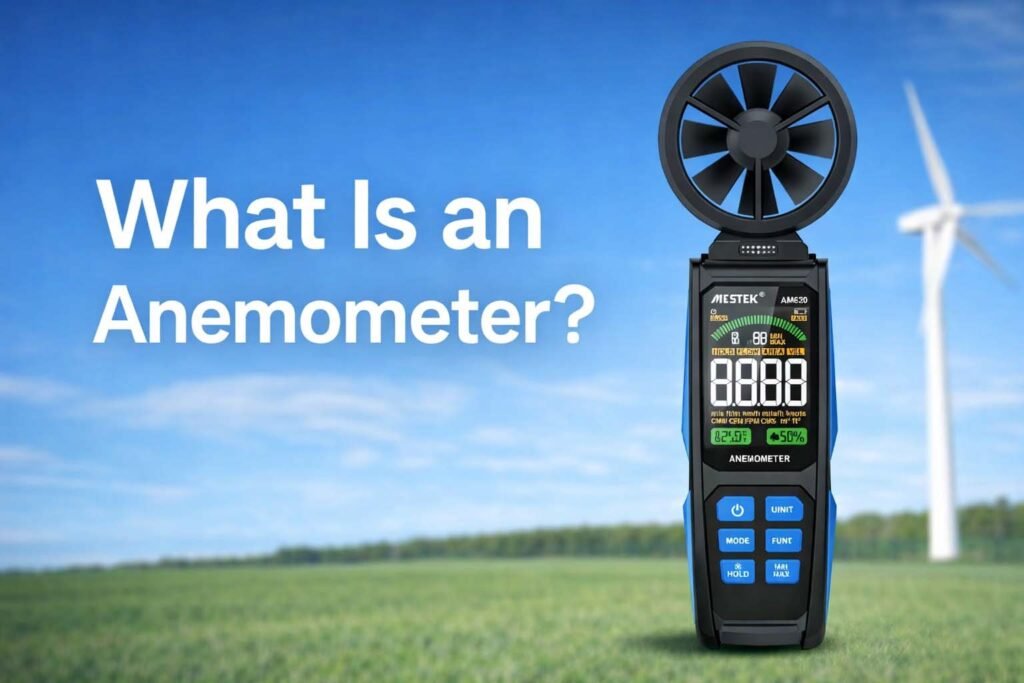
Yes, many handheld units include a temperature sensor. MESTEK AM10, AM610, and AM620 all measure air temperature along with wind speed.
3) Are anemometers waterproof?
Some outdoor models are weather resistant, but handheld HVAC models should be kept dry.
4) How accurate are handheld anemometers?
Good handheld models are about ±3% accuracy for speed with 0.1 m/s resolution. For HVAC that’s more than enough for balancing and diagnostics. MESTEK AM620 is in this professional accuracy class.
5) Can I use an anemometer indoors?
Yes. HVAC technicians use them indoors to measure duct velocity and ventilation effectiveness
Conclusion
An anemometer isn’t just a wind meter. It is a smart tool that helps improve safety, accuracy, and performance wherever airflow matters. Whether you’re flying a drone, checking HVAC systems, studying weather, or working on-site, the right anemometer makes wind measurement easy and reliable.
If you need a durable and accurate option, explore the MESTEK anemometer models. They offer professional results and are simple to use. With these tools, you can measure wind confidently anytime, anywhere.