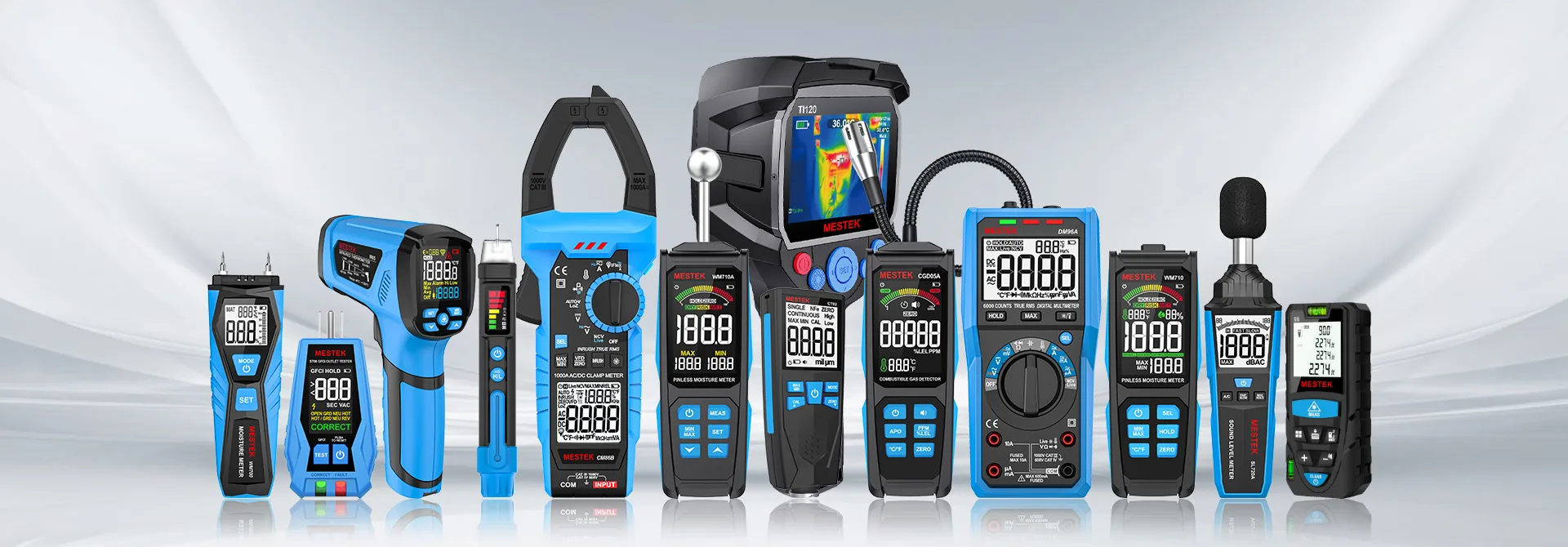
Infrared thermometers have become everyday tools in homes, factories, kitchens, hospitals, and maintenance environments. Their ability to measure temperature instantly and without physical contact makes them fast, safe, and convenient. Despite this widespread use, many people still believe infrared thermometers are inaccurate, unreliable, or misleading.
In reality, infrared thermometers are more often misunderstood than flawed. Most complaints about accuracy stem from incorrect expectations or improper use, not from the technology itself. Misconceptions about lasers, distance, emissivity, and what these devices actually measure frequently lead to confusion. This article debunk common myths about infrared thermometers, providing clarity on their functionality, limitations, and proper usage techniques.
Myth 1: Infrared Thermometers Are Inaccurate
Many people dismiss infrared thermometers as unreliable tools. However, this perception largely stems from misunderstandings about their capabilities and proper use. In reality, quality infrared thermometers offer considerable accuracy when used correctly.
Typical accuracy range
So, how accurate are infrared thermometers? Accuracy depends on the device’s design, sensor quality, and intended application. Most consumer-grade infrared thermometers are designed to provide readings within ±1°C to ±2°C (±2°F to ±4°F) under ideal conditions. This level of accuracy is more than sufficient for household tasks, food surface checks, HVAC diagnostics, and general maintenance work.
Professional and industrial-grade infrared thermometers often achieve ±0.5°C (±1°F) or better, with higher repeatability across repeated measurements. Medical infrared thermometers are subject to even stricter performance requirements, as devices used for skin temperature screening must comply with international accuracy standards.
Instrument error vs. improper use
It helps to separate two different sources of inaccuracy:
- Instrument error refers to the inherent tolerance specified by the manufacturer. This includes sensor limitations, calibration drift over time, and response speed. Under normal operating conditions, this error is small and consistent.
- User error is the most common cause of inaccurate readings. This includes measuring from too far away, targeting reflective surfaces, ignoring emissivity differences, or attempting to measure through glass or plastic.
In most cases, the thermometer is functioning properly, but it is being used outside its intended operating conditions.
Core Factors That Affect Accuracy
Three primary factors influence infrared thermometer accuracy:
- Distance-to-Spot Ratio (D:S): As distance increases, the measurement area becomes larger, potentially mixing background temperatures with the target.
- Surface Type: Shiny or reflective surfaces can reflect ambient infrared radiation, distorting readings.
- Emissivity: Different materials emit infrared energy differently. Most infrared thermometers assume an emissivity near 0.95, which works well for matte and organic surfaces.
When these factors are understood and controlled, infrared thermometers can deliver reliable and consistent results.
Myth 2: The Laser Measures Temperature
Many people believe the visible laser beam emitted by infrared thermometers is responsible for measuring temperature. This misunderstanding is so common that it has led many users to ask, Are laser thermometers accurate, or to assume the laser itself is doing the measuring. In reality, this belief is incorrect and often leads to improper use of the device.
The Laser Is Only an Aiming Aid
So, what does the laser do on an infrared thermometer? Simply put, the laser is a visual guide. The laser does not measure temperature. It helps the user aim the thermometer at the intended target area, nothing more.
The temperature measurement occurs entirely independently of the laser. An infrared thermometer will still measure temperature accurately even if the laser is turned off. On the other hand, shining the laser on an object without activating the infrared sensor will not produce any temperature reading.
Different devices use different laser configurations:
- Single-point lasers indicate the approximate center of the measurement area
- Dual lasers help outline the edges of the measurement zone
- Crosshair or multi-point lasers provide more precise visual targeting
Regardless of configuration, the laser is strictly a visual guide.
How Infrared Thermometers Actually Measure Temperature
Infrared thermometers work by detecting infrared radiation naturally emitted by objects. Any object above absolute zero emits infrared radiation, and its intensity correlates with the object’s surface temperature.
Inside an infrared thermometer are several critical components:
- An optical lens to collect infrared radiation
- A detector (usually a thermopile) that converts radiation into an electrical signal
- Internal sensors to compensate for ambient temperature
- Signal processing electronics that calculate and display temperature
The detector is sensitive only to infrared wavelengths, not visible light. A helpful analogy is to think of an infrared thermometer as a single-pixel thermal camera that measures the average temperature of a defined area.
Understanding the Measurement Area (Spot Size)
Infrared thermometers do not measure a single pinpoint. They measure the average temperature of a circular area, often referred to as the spot size. The size of this spot depends on:
- The thermometer’s distance-to-spot ratio
- The distance between the device and the target
As distance increases, the spot size grows. If the target does not completely fill the measurement area, surrounding temperatures influence the reading. This concept is critical to understanding why readings may change as you move closer or farther away, even when aiming at the same object.
Myth 3: Infrared Thermometers Can Measure Internal Temperature
Another common misunderstanding is the assumption that infrared thermometers can measure internal or core temperature. In reality, infrared thermometers are strictly surface temperature measurement tools.
Surface Temperature Only
Infrared thermometers measure infrared radiation emitted from the outermost surface of an object. This radiation does not penetrate solids, liquids, or food. As a result, infrared thermometers cannot measure internal temperatures. This limitation is rooted in fundamental physics, not in device quality or sensor performance.
Some thermometers combine infrared sensors with contact probes, allowing internal temperature measurement through direct contact. In these hybrid devices, the probe, not the infrared sensor, is responsible for measuring internal temperature. For example, a thermocouple-equipped thermometer such as the IR06 can measure internal temperatures using its probe, while infrared mode remains limited to surface readings.
Why Infrared Cannot See Inside Objects
Infrared radiation is emitted exclusively from the surface layer of materials. It cannot pass through solid objects or liquids to reveal internal conditions. For this reason, infrared thermometers:
- Cannot determine internal food temperatures
- Cannot measure liquid temperature below the surface
- Cannot detect internal overheating of machine components
- Cannot accurately measure core body temperature
When these limitations are ignored, users may incorrectly label the device as an infrared thermometer inaccurate, even though it is performing exactly as designed.
This is why non-contact thermometer accuracy should always be judged by surface measurements, not internal verification.
Common misuse scenarios
Misinterpretation frequently occurs in everyday situations:
- Cooking: A steak may read 160°F on the surface while remaining undercooked inside.
- Food safety: Infrared thermometers cannot verify the required internal cooking temperatures.
- Equipment checks: Measuring an outer housing does not reveal internal component heat.
- HVAC: Measuring vent surfaces does not reflect actual air temperature.
Understanding this limitation helps users choose the right tool. Infrared thermometers excel at fast surface scans, while probes and contact sensors remain essential for internal temperature measurement.
Myth 4: Distance Does Not Affect Accuracy
Many users blame inconsistent readings on device quality when the real issue is distance. Infrared thermometers do not measure a single point. They measure an area, and that area expands as the distance increases. When distance is ignored, infrared thermometer accuracy distance issues are almost guaranteed.
Distance-to-Spot Ratio explains why distance matters
The key concept here is the distance-to-spot ratio (D:S), sometimes called the distance-to-target ratio. It tells you how large the thermometer’s measurement “spot” becomes at a given distance. For example, a 12:1 D:S ratio means the thermometer measures about:
- 1 inch wide at 12 inches away
- 2 inches wide at 24 inches away
- 4 inches wide at 48 inches away
So the greater the distance, the larger the measurement area and the easier it is for the reading to include nearby surfaces, air gaps, or background objects. That’s why small targets (like a wire, small pipe, or circuit component) often read incorrectly when measured from too far away.
Why choosing the right distance is essential
For reliable readings, the target must completely fill the measurement spot. If the spot is larger than the object, the thermometer averages temperatures from both the target and its surroundings, which can cause readings to appear lower, unstable, or misleading.
For best accuracy:
- Check your device’s D:S ratio
- Move closer when measuring small objects
- Don’t assume the laser shows the full spot size (it usually marks only the center)
Distance is not a minor detail. It is one of the most important factors in achieving accurate and repeatable infrared temperature measurements.
Myth 5: All Infrared Thermometers Work the Same
Many people assume that all infrared thermometers produce the same results. In reality, performance can vary significantly, especially when measuring different surface types. The primary reason for these differences is infrared thermometer emissivity, a critical factor that directly affects measurement accuracy.
Emissivity: What It Means (and Why It Matters)
Emissivity describes how well a material emits infrared (heat) energy compared to a perfect emitter, called a blackbody. It is measured on a scale from 0.00 to just under 1.00.
Highly emissive materials (close to 1.00) emit heat efficiently, improving the accuracy of temperature readings. Materials with low emissivity reflect infrared energy from their surroundings, which can confuse the thermometer and cause inaccurate readings.
Most infrared thermometers are preset to an emissivity of about 0.95, because many everyday materials fall close to this value. For example, most organic materials have an emissivity around 0.95, while water and human skin are even higher, around 0.98. These surfaces are ideal for infrared measurement.
How Different Materials Affect Readings
Emissivity varies widely depending on the surface being measured:
- Matte or organic surfaces (wood, food, painted walls) generally produce reliable readings
- Shiny or metallic surfaces (polished aluminum, stainless steel) have very low emissivity, sometimes as low as 0.02–0.10, and tend to reflect ambient heat rather than emit their own
This is why a shiny metal pot can display a surprisingly low temperature reading even when it is extremely hot.
The Difference Between Adjustable and Fixed Emissivity
Infrared thermometers typically fall into two categories based on emissivity control:
Fixed emissivity models are typically preset at 0.95 for simplicity and affordability. These work well for household use and organic materials but often struggle with reflective or metallic surfaces.
Adjustable emissivity models allow users to set emissivity values (usually from 0.10 to 1.00), significantly improving accuracy across a broader range of materials. For this reason, professionals often prefer an emissivity infrared thermometer when working with metals, plastics, glass, or industrial equipment.
Conclusion
The most common myths about infrared thermometers arise from misunderstanding, not from technological flaws. When used correctly, these devices provide fast, reliable surface temperature measurements. The laser only helps with aiming. Distance affects spot size, and emissivity plays a major role in accuracy across materials. Infrared thermometers are not meant for internal temperature measurement, but they excel at safe, non-contact surface scanning. With proper knowledge and realistic expectations, infrared thermometers remain dependable tools across homes, workplaces, and technical environments.