Do you really understand moisture meter?


You have prepared all the materials for DIY your house.

But whether the environment you live in is humid or too dry. This has become your current problem.

Because you can’t adapt them to the environment.

Too humid ground will make the wood board moldy and spotty in a short time, while too dry will make the wood board crack.

Don't worry, a short article will help you choose the moisture meter that's right for you.

Pinless moisture meters and pin-type moisture meters are the two most common moisture measuring instruments. Pin-type moisture meters can be directly inserted into the wood or material to be measured. The instrument measures the resistance between the built-in pins through electrodes. The size of the resistance is affected by the moisture content of the material. By observing whether the resistance is close to the standard value of the material, it can be judged whether the wood or material meets the standard.
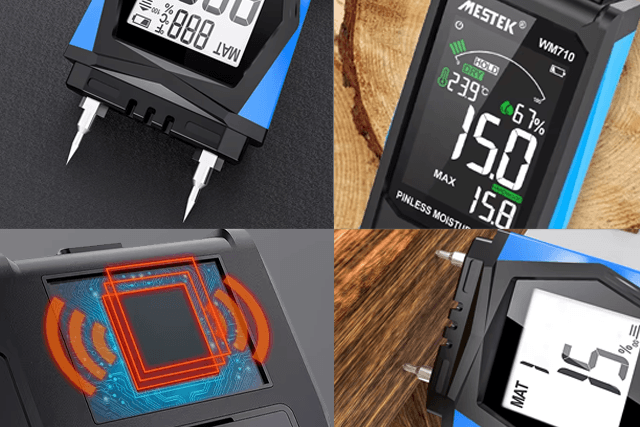
The working principle of the pinless moisture meter is relatively simple to understand. Its electrode plate only needs to contact the surface of the material to work, and the relative moisture content of the material is measured by the generated electric field. The working principles of these two moisture meters are basically the same.

So, what is the right moisture meter for you?

First, make your goal clear. If you just need to know the moisture content of your concrete floor, then you can choose a pin-type moisture meter. Even if the measurement process will leave holes in your floor, it will eventually be covered by your wooden boards, so you don’t have to worry about it.

The ASTM standard is that the relative humidity of concrete should be less than 75%. Of course, this is not the only standard. You also need to know what humidity the material you purchased can withstand? You can ask the manufacturer, usually find this information on the wood manufacturer’s website. After waiting for the concrete to reach the appropriate ambient humidity, you can decorate your room as you like. When you are preventing the wood wall from getting moldy and spots, and you don’t want a pin-type moisture meter to leave a bunch of holes after measuring, then a pinless moisture meter will be your best choice.

Time and effort are two important factors when choosing a moisture meter.

Time and effort are two important factors when choosing a moisture meter.

  • The volume of wood you work with and the time it takes to measure with the meter.
  • You need to repeatedly measure the moisture content of the wood to experiment.
  • You need to handle a lot of wood regularly.
  • You don’t have time to learn how to change the pins on a hygrometer.
  • The material you are working with is hard, such as hardwood

In this case, a pinless moisture meter is more suitable because your energy should not be wasted repeatedly inserting the pin into the wood.

  • You only have to deal with less wood.
  • You may only need to take a few simple instrument readings.
  • The wood you treat will easily fit the pins.

Then, the needle moisture meter will be the best choice, it is relatively simple to operate


Next, I will recommend you a more practical moisture meter, a moisture meter with a spherical probe.

It is also a pinless moisture meter, but it is more convenient and quick to use, and it has a unique ball shape. It has a unique way of calculating the moisture content of four materials, namely drywall, concrete, cork, and hardwood. After you get the standard moisture content of this material, you can set it to a dangerous or warning state, and it will issue a warning when it reaches this value.

Share our interesting knowledge and stories on social media

Have questions? Get a quote

Want to learn more? Click the button now.

More Posts>>>

This diagram illustrates how to measure AC/DC current using a clamp meter.

How to Measure DC Current with a Clamp Meter

Clamp meter is an electrical testing instrument designed to measure current by clamping around a conductor. Unlike traditional current measurement methods that require the circuit to be opened, a clamp meter allows non-contact current measurement, improving safety and efficiency. Modern clamp meters often combine multiple functions into one device, working not only as a clamp meter tester, but also as a voltage tester, resistance meter, and continuity tester. Many models support both AC and DC measurements, making them suitable for a wide range of applications. How does the clamp meter work? For DC current measurement, most AC DC clamp meters

A kitchen thermometer is testing the temperature of a frying pan.

5 Common Myths About Infrared Thermometers

Infrared thermometers have become everyday tools in homes, factories, kitchens, hospitals, and maintenance environments. Their ability to measure temperature instantly and without physical contact makes them fast, safe, and convenient. Despite this widespread use, many people still believe infrared thermometers are inaccurate, unreliable, or misleading.  In reality, infrared thermometers are more often misunderstood than flawed. Most complaints about accuracy stem from incorrect expectations or improper use, not from the technology itself. Misconceptions about lasers, distance, emissivity, and what these devices actually measure frequently lead to confusion. This article debunk common myths about infrared thermometers, providing clarity on their functionality, limitations,

The maintenance personnel are checking why the dryer keeps tripping breaker.

5 Common Reasons Your Dryer Keeps Tripping the Breaker

If your dryer keeps tripping the circuit breaker, it’s not random—and it’s not something you should ignore. A tripping breaker is designed to protect your home from electrical overloads, short circuits, and potential fire hazards. In this article, we’ll walk through 5 common reasons a dryer trips the breaker, and explain how each issue can be identified through proper electrical checks. 1. Circuit Overload from High Current Demand One of the most common reasons a dryer trips the breaker is circuit overload. Electric dryers draw a significant amount of current, especially during the heating cycle. If the dryer shares a

The image depicts a pyrometer measuring the temperature of a furnace.

What Is a Pyrometer?

A pyrometer is a specialized non-contact temperature measuring instrument designed to determine the surface temperature of objects, especially at high temperatures where conventional thermometers cannot be used. By interpreting emitted thermal radiation, pyrometers provide fast, reliable readings without touching the target. This makes them indispensable in many industrial settings including steel mills, glass production, power plants, and materials processing. Why Pyrometers Are Important In many industrial processes, accurate temperature control is crucial for quality, safety, and efficiency. Direct contact sensors can be impractical or impossible at very high temperatures, moving objects, or hazardous conditions. Pyrometers enable temperature monitoring without contact,

Get more information

Scroll to Top